
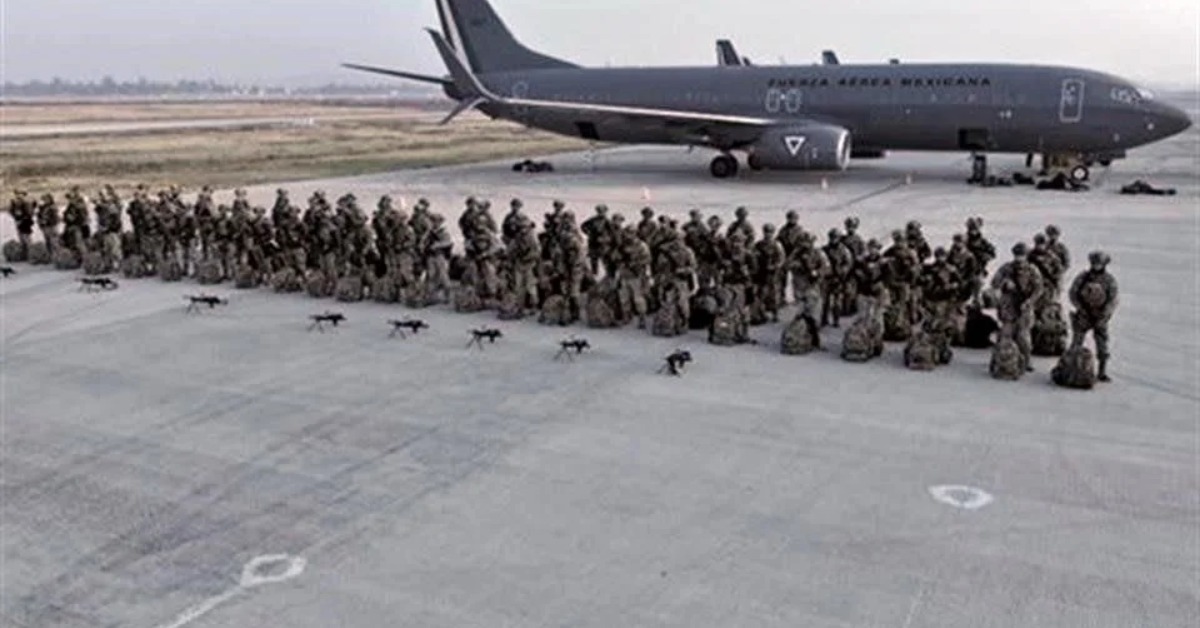
Mexico has sent 1,170 Army personnel to Tijuana, Ciudad Juárez, and León as part of its latest security reinforcement. The move is easy to describe and harder to judge. It brings more soldiers, more patrols, and more federal visibility to three cities long tied to criminal pressure, border tension, and industrial corridors under strain. The bigger question is what happens after the airlift: whether the added force changes daily conditions on the ground, or simply shows how often violence pulls the government back to the same places.
Why these three cities matter
Mexico has launched another visible security reinforcement in three cities that remain near the center of the country’s violence map. The Army airlifted 1,170 personnel to Tijuana, Ciudad Juárez, and León on Wednesday afternoon, using three Air Force transport aircraft. Officials said the move forms part of the National Security Strategy and includes 270 members of the Brigada de Fusileros Paracaidistas, a rapid-response paratrooper unit. The stated mission is to reinforce existing military zones, support the National Guard, and expand patrol and deterrence operations against criminal groups. The message is clear. The federal government still sees these three cities as places that require a strong federal presence, not only local policing.
The selection was not random. Tijuana and Juárez are two of Mexico’s most important border cities. Both sit on corridors tied to drug trafficking, arms flows, migration, and cross-border commerce. León is different, but not disconnected. It sits inside Guanajuato’s industrial corridor, where homicide, extortion, and criminal disputes have pushed security into daily life for businesses and families. Federal figures released this month placed Guanajuato first nationwide in homicide share so far this year, with Chihuahua and Baja California also among the most affected states. Independent homicide mapping for 2024 also showed Tijuana, Juárez, and León among the municipalities where lethal violence remains heavily concentrated.
What the deployment actually means
For international readers, the airlift matters because it shows how Mexico’s security problem remains concentrated, even when national indicators improve. The federal government says homicides have fallen sharply since late 2024. Yet the same cities keep returning as federal priorities. That is why troop reinforcements keep circling back to the same map. This operation does not create a new legal framework. Officials described it as a reinforcement under existing rules, with troops working alongside federal, state, and municipal authorities. They said the mission centers on deterrence, prevention, and patrols, while staying within Mexico’s Law on the Use of Force and human-rights obligations.
The local context helps explain the urgency. In Ciudad Juárez, local reporting on Thursday said a fresh contingent of soldiers and paratroopers had already arrived to join a large federal force operating in the city. In León, local officials said February closed with 41 homicides and that most were linked to drug activity. Business groups in Guanajuato have also kept extortion high on the public agenda. In Tijuana, tourism operators recently reported cancellations tied to the security climate. These are different symptoms, but they point to the same reality. The pressure is not only about headline violence. It also touches trade, mobility, tourism, and the basic confidence that keeps a city functioning.
Readers living in or passing through these cities should expect a more visible federal posture in the near term. That can mean more patrols, more inspections, and a heavier military presence near transport routes, border approaches, and other priority zones. Some residents welcome that visibility. Others see it as evidence that civilian institutions still lack enough capacity to hold the line on their own. Both reactions coexist in Mexico’s security debate. Military reinforcement can quickly change the security landscape. It is slower and much harder to prove that it has changed the underlying criminal balance.
What to watch next
The next meaningful test will not be the arrival itself. The results that follow. Authorities will need to show whether the reinforcement leads to arrests, weapons seizures, lower homicide counts, stronger investigations, and pressure on extortion networks. Without that, a large airlift can change optics faster than conditions. With that, the government may argue it has a repeatable model for high-pressure cities. Either way, this deployment is a reminder that Tijuana, Juárez, and León remain places where national security policy stops being abstract and becomes visible on the street.