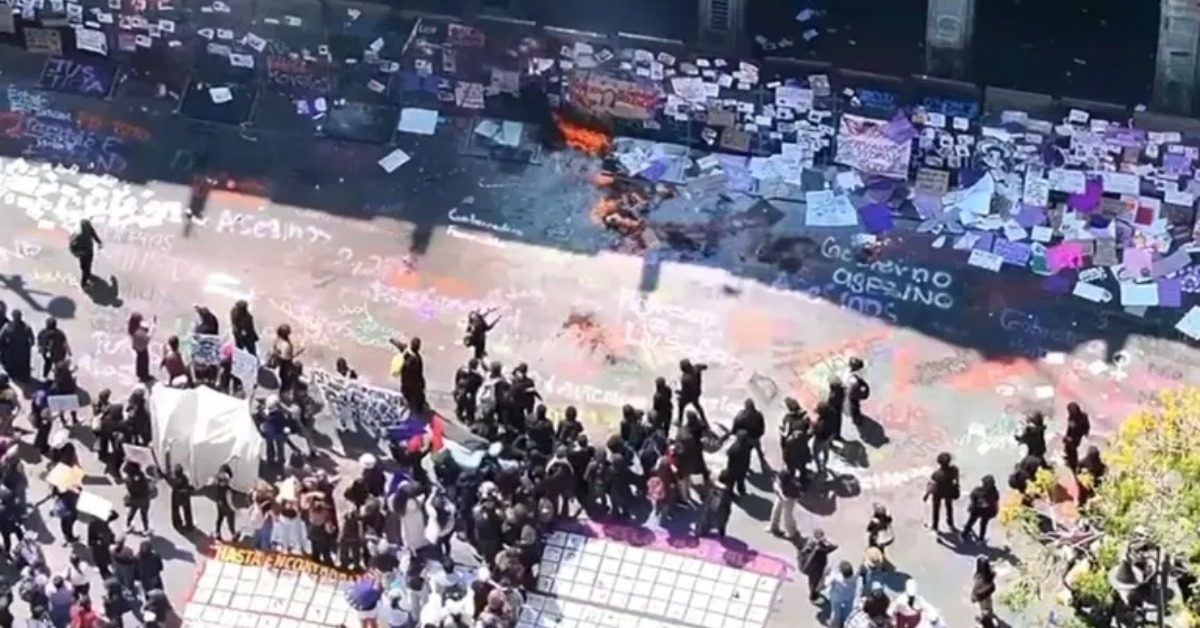
The central 8M story in Mexico was not only the scale in the capital. Marches spread from Cuernavaca to Campeche, reaching far beyond the usual national focus. They showed how local grief and unresolved cases still drive the movement. By March 9, national reporting had logged unrest in nine states. Arrest counts also shifted as local authorities released updates. The result was a day of mass turnout, visible mourning, and, in some cities, sharp confrontations with police and government buildings.
A national 8M beyond the capital
Mexico’s 8M marches unfolded as a national mobilization across Mexico on March 8. They were not only a Mexico City event. Women marched in state capitals, border cities, and smaller municipalities. Their demands were familiar and direct. They called for action on feminicides, disappearances, sexual violence, and violence against women. They also demanded abortion rights, where access remains restricted. The main fact of the day was the demonstrations’ reach. By March 9, a national roundup had reported unrest in nine states. That early account put the number of arrests at least 15. Later local updates raised some state totals. That means the final number may be higher than the first national count. Across reports, the pattern stayed clear. Large peaceful contingents filled central streets. Smaller groups tore down barriers, painted buildings, or clashed with police. That contrast showed both the movement’s breadth and the depth of public anger in many communities.
Where tensions rose
Several flashpoints were in Morelos, Campeche, Oaxaca, and the State of Mexico. In Cuernavaca, anger was sharpened by the recent killings of two university students. Their cases shaped the protest there. Marchers and members of the so-called black bloc attacked the state government palace. Molotov cocktails caused a small fire. In Campeche, protesters pushed against barriers around the Palace of Government. Official updates on March 9 said 14 people were arrested there. Earlier reports had placed the number at 11. Authorities also reported injuries among female police officers. In Oaxaca, riot police pushed back demonstrators after confrontations near the government palace. Three detentions were reported there. In Toluca, marchers pulled down barriers and painted the state palace. Separate reporting also logged damage or confrontations in parts of Guanajuato, Veracruz, and other states. That reinforced how widely the tensions spread across several parts of Mexico that day.
Why the nationwide spread mattered
The marches were driven by long-standing grievances, but this year’s mobilizations also carried the weight of fresh local cases. In Morelos, the deaths of the two university students became a rallying point. More broadly, the protests returned to familiar demands. Women called for justice for those who were killed. Families demanded answers for the disappeared. Survivors demanded punishment for sexual aggressors and a more serious response from institutions. Official statistics help explain why the movement still fills the streets. The latest ENDIREH survey from INEGI offers one measure of that pressure. It found that 70.1 percent of women aged 15 and over had experienced violence. It covers at least one form at some point in their lives. That background helps explain why the marches looked both broad and personal. Students, mothers, search collectives, older women, and families with children walked together. In several states, they passed churches, banks, congress buildings, and palaces that had been boarded up before the marches began. The barriers showed that authorities expected confrontation.
For readers tracking Mexico from outside activist networks, one point emerges. The 8M protests were not confined to the capital. The unrest was not limited to one city. The synchronized spread across the country turned March 8 into a national measure of unresolved anger over violence against women. In some places, the day ended with speeches, performances, and memorials. In others, it ended with paint, broken glass, fire damage, or detentions. Both realities were part of the same story. The peaceful scale of the marches showed how deep the support base remains. The confrontations showed how quickly recent cases and years of impunity can sharpen public anger. They also increased pressure on governors, prosecutors, universities, and local police. That is why the national picture matters. It was not only about crowd size or damage totals. It was also about how many communities used International Women’s Day to send the same message. The crisis remains present and unresolved in Mexico.