Some families from a small northern town still live away from home, years after a cartel attack. A US case is now treating that episode as evidence of how the accused operated and how dangerous he remains. Victims say they have waited through apologies, filings, and stalled compensation with little closure. What does a courtroom in Washington actually change for people who lost relatives and property in Mexico? And what should be expected next?
Survivors’ accounts and the reparations gap
Fifteen years after the killings in Allende, some families remain displaced. Many focus on one question: who will be held responsible at the leadership level. A survivor interviewed this week said her family fled in 2011 and later lost relatives after they returned. Her father went back after a year, and she says he had disappeared. She also said her brother was last seen in 2012. She expects the clearest accountability to come from US courts, not Mexican agencies. She points to a 2018 human-rights recommendation and a public apology delivered the following year. After that, she says the fight moved into a bureaucratic battle over compensation and responsibility. She described the federal Comisión Ejecutiva de Atención a Víctimas. She said a state counterpart kept shifting the file back and forth. She said the process has continued through court filings and repeated deadline extensions. She criticized reported compensation figures, including a proposed 250,000 pesos, as far below losses. For her, the US case is a chance to test claims that cartel leaders ordered the attacks.
What the US indictment puts on the record
The US federal case tied to Allende is in the U.S. District Court for the District of Columbia. A fifth superseding indictment filed in 2024 names Miguel Ángel Treviño Morales and Omar Treviño Morales. It charges them with a continuing criminal enterprise and related drug, firearms, and money-laundering counts. The indictment describes the Zetas and their successor, the Cartel del Noreste, as using violence to control territory. It alleges the defendants executed dozens of residents living around Allende in March 2011. One murder conspiracy allegation dates killings to about March 17 through March 20, 2011. The document invokes extraterritorial jurisdiction because the killings are tied to major narcotics offenses. US authorities said Mexico transferred the brothers into US custody on February 27, 2025. They were arraigned in Washington in March 2025. The core charge can carry life imprisonment or the death penalty under federal law. The allegations are unproven, and the defendants are presumed innocent.
How a US case can serve victims outside the United States
For victims outside the United States, a US prosecution can still be used as leverage. Federal law gives crime victims the right to notice, to attend, and to be heard at plea and sentencing. Victims also have a right to confer with prosecutors and to seek restitution when the law allows it. The U.S. Department of Justice asks victims to describe emotional, physical, and financial harm in a victim impact statement. In practice, foreign victims face barriers, including safety risks, distance, language, and proving losses from older crimes. The court can accept written statements, and prosecutors can offer additional security measures when needed. Even when restitution is ordered, collection depends on assets and forfeiture, and that process can be slow. The Treviño case also shows why prosecutors push for strict jail limits in some cases. Special Administrative Measures are authorized by regulation when officials say a prisoner’s communications could lead to death or injury. Motions to loosen those limits can serve as a public window into evidence the government expects to present at trial.
Mexico’s unresolved obligations
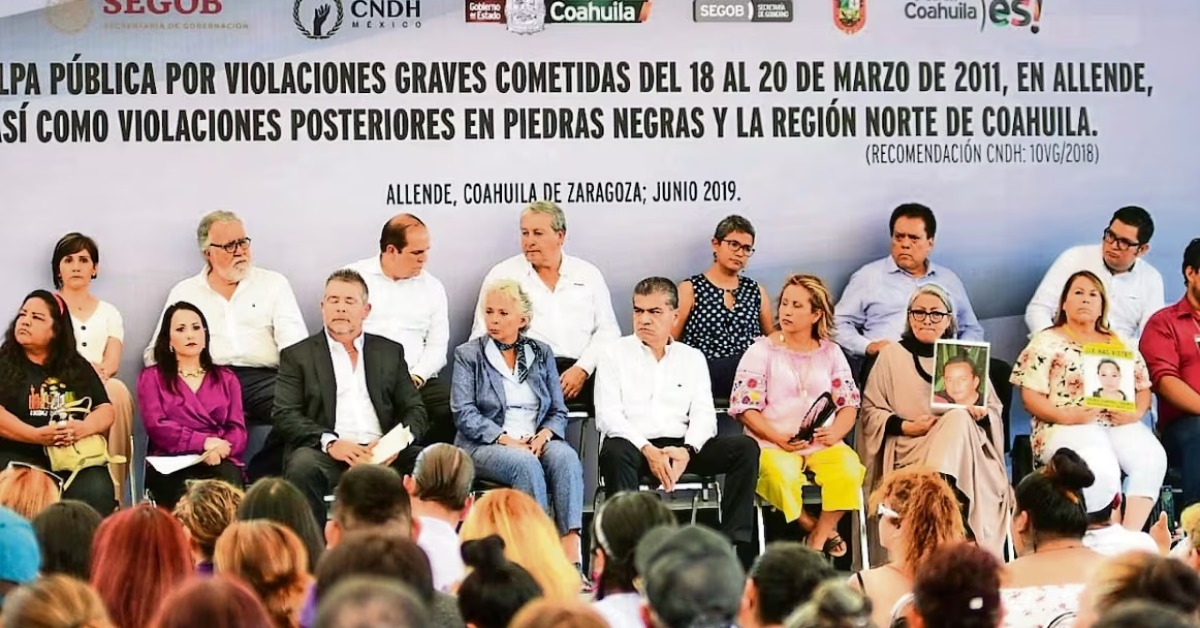
Mexico has taken some steps, but survivors describe the response as incomplete. A public apology was delivered in Allende in June 2019 by federal, state, and municipal officials, including Olga Sánchez Cordero. One account of that event said the attack destroyed 48 homes and ranches. Families attending said they wanted reparations, access to justice, and punishment, not symbolic events. The apology followed a 2018 national human-rights recommendation issued by the Comisión Nacional de los Derechos Humanos about killings and displacement in March 2011. Official victim counts remain contested, and even detailed investigations warn that no final total may be possible. One account says the rights commission identified 49 victims, while community estimates reach into the hundreds. Researchers who reviewed investigative files also emphasize uncertainty, citing destroyed evidence and delayed forensics. That uncertainty complicates reparations, because compensation requires registries, valuations, and documentation. Survivors say those procedures have stalled, leaving families with unresolved debts and property claims. Independent researchers note that only a limited number of perpetrators and officials have been convicted so far.
What to watch in 2026
The next major milestone is procedural, not evidentiary. The federal judge, Trevor McFadden, set the next status hearing for May 1, 2026. Reports from earlier hearings cite the volume of discovery as a reason for the long schedule. Defense teams have also raised conflict-of-interest issues and jail conditions as the case moves forward. Separately, prosecutors have been litigating the extent of contact Treviño Morales can maintain while detained. In January 2026, his lawyers asked to have the Special Administrative Measures lifted, according to reports. That reporting says the measures were approved by Pam Bondi. Prosecutors opposed the request, arguing that communications could endanger witnesses and others. Prosecutors have also said they are preparing another superseding indictment with added detail. Those briefs preview a theory linking Allende to retaliation after suspected cooperation with the Drug Enforcement Administration. For residents and expats in Mexico, the practical signal is time: this process will likely move slowly. But each filing can add detail that victims say they have struggled to obtain at home.