
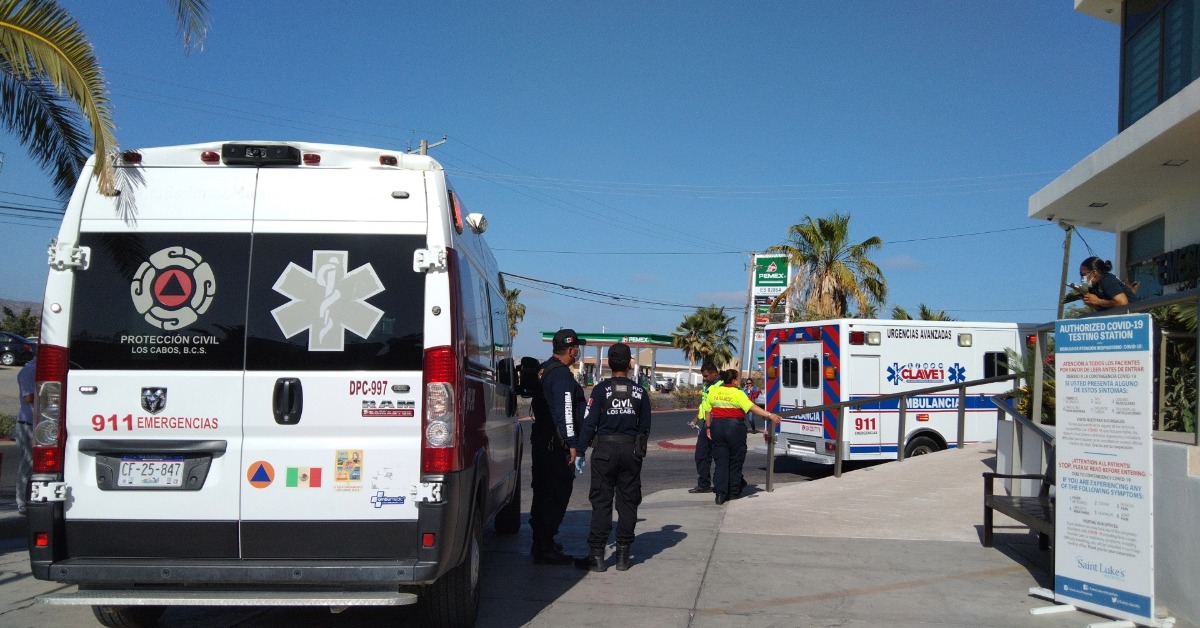
A pre-dawn emergency call in Cabo San Lucas ended before the hospital was reached. A woman went into active labor during an ambulance transfer from Los Cangrejos, and the crew had to complete the delivery on board. Both mother and baby were later reported in good condition. The incident drew attention not only because of the birth itself, but because it shows how emergency medical response works in Los Cabos, where firefighters often serve as frontline ambulance crews.
Baby arrives before the hospital
A pre-dawn emergency transfer in Cabo San Lucas ended with a baby boy being delivered inside a fire department ambulance before the patient reached the hospital.
According to the information released Thursday, a pregnant woman went into labor while she was being transported by the Cuerpo de Bomberos de Cabo San Lucas. The delivery took place inside ambulance S77, turning a routine emergency transfer into an on-board birth.
The call was reported at about 3:30 a.m. from Los Cangrejos, a neighborhood in Cabo San Lucas. Paramedics Saúl Martínez and Yazid Pavón assisted the birth during the ride to a medical facility. The department later said both the mother and the newborn were in good condition and received medical attention after the delivery.
On the surface, it is a straightforward local public safety story. A medical emergency happened. Responders arrived. A baby was born. But the episode also gives readers a clearer picture of how emergency response works in this part of Los Cabos, especially for people who are new to the region or familiar only with U.S. or Canadian systems.
Why firefighters handled the call
For many international readers, the detail that stands out is not only that the baby was born before arrival. It is that firefighters were the medical team on scene.
In Cabo San Lucas, the fire department does more than fight fires. Official information from the department shows it operates three ambulances and provides free pre-hospital emergency care across the city. The same service also handles some local patient transfers and supports public events when needed. That helps explain why a labor emergency was handled by firefighters and paramedics rather than by a hospital-based crew alone.
This is an important point for foreign residents, snowbirds, and frequent visitors. In practical terms, the local emergency chain often starts with the nearest trained public safety responders, and in Cabo San Lucas, that can mean a fire department ambulance. The people who arrive first may be dealing with a car crash, a fall, a medical episode, or, as this case shows, a birth in progress.
The department also maintains a round-the-clock emergency service. That matters in a fast-growing coastal city where distance, traffic, and geography can shape how quickly a patient gets from a neighborhood call to a hospital bed.
What this says about Los Cabos emergency care
The incident also fits into a broader pattern. Official department figures show that medical and ambulance calls make up a large share of the fire department’s workload.
In 2024, the Cabo San Lucas fire department reported 3,893 emergency services. Of those, 1,762 were pre-hospital ambulance responses. That means ambulance work was not a minor side task. It was one of the institution’s central functions. The same official report shows that the department’s operations depend on a mix of ambulances, rescue vehicles, fire engines, and multiple dispatch points.
Local authorities have also been trying to improve that coverage. In 2025, the city announced a new emergency dispatch module in the tourist corridor to help cut response times for traffic accidents, rescues, and pre-hospital services on beaches, in residential areas, and in nearby developments. That move reflected a basic reality in Los Cabos: emergency demand is spread across neighborhoods, highways, resort zones, and areas used by both residents and visitors.
That context makes Thursday’s ambulance birth more than an unusual headline. It shows the unpredictable nature of the call that emergency crews must be prepared to handle at any hour. A labor transfer can remain routine for most of the trip, then become an immediate delivery with no time left to reach the hospital.
For readers living in Mexico or considering a move, that is the most useful takeaway. Emergency response in Cabo San Lucas is not limited to fire suppression. It includes a significant medical role, and in urgent cases, the first treatment may begin inside a moving ambulance. In this case, that response was enough to bring a baby into the world safely before the hospital doors were reached.
With information from Tribuna de México, Cuerpo de Bomberos de Cabo San Lucas, Bomberos Voluntarios de Cabo San Lucas