
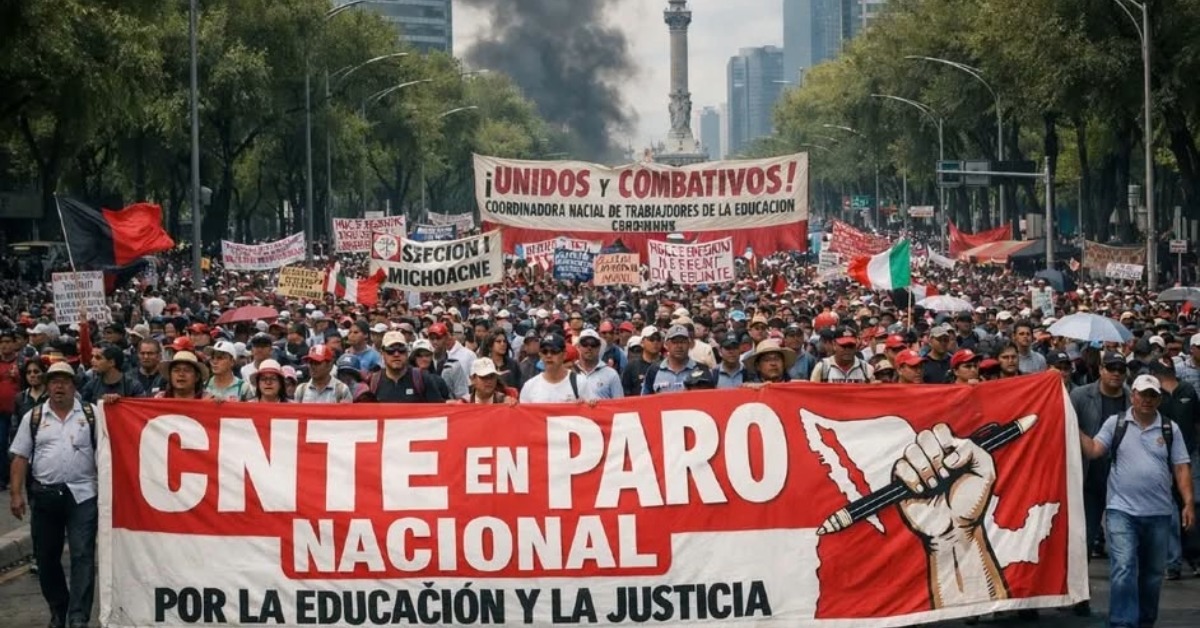
Mexico City is bracing for another showdown with CNTE as teachers begin a 72-hour national strike, march toward the Zócalo, and threaten broader disruptions if talks fail. Traffic alerts are the easy part to understand. The harder question is why the same pension fight keeps returning, even after last year’s negotiations. The answer sits inside Mexico’s public-sector retirement system, the rules that shape teachers’ careers, and a union that still knows how to turn street pressure into political leverage.
The strike returns to the capital
The CNTE, Mexico’s dissident teachers’ movement, launched a 72-hour national strike on Wednesday, March 18, with its main show of force in Mexico City. Leaders called for a morning march from the Ángel de la Independencia to the Zócalo. They also planned a camp in the main square through Friday. That puts pressure on the federal government and on daily life in the capital at the same time. Residents, workers, and visitors can expect slower traffic, closures near the historic center, and tighter security around Palacio Nacional.
Parallel actions are planned in several states where the CNTE has a strong base. In some places, that means school disruptions. In others, it means toll-booth takeovers, protests at government offices, and local marches. Union leaders have also left open the possibility of extending the protest if negotiations stall. So while the action is officially set for three days, officials are treating it as the opening move in a larger test.
What teachers want this time
The immediate demands are broad but familiar. The union wants the repeal of the ISSSTE 2007 law, an end to USICAMM, a 100% raise to base pay, the return of dismissed workers, and direct talks with the federal government. USICAMM is the teacher career system that governs hiring, promotion, and placement. The CNTE says both the pension framework and the career rules weakened labor rights and made advancement more bureaucratic.
That is why this is not just another street protest. The union sees it as a fight over how teaching is governed and how retirement is financed. When leaders talk about pensions, they are also talking about the balance of power between teachers and the state. The movement argues that official reforms have changed the system’s language without altering its structure.
The pension fight underneath the march
For international readers, the pension dispute is the key to the story. ISSSTE is Mexico’s social security system for state workers. A 2007 reform moved many workers into individual retirement accounts managed through the Afore system, instead of the older solidarity-based model many teachers preferred. The CNTE has treated that change as unfinished business ever since.
Some workers stayed under a transitional track, while others entered the individual-account system. The government later lowered the retirement age for some workers in that transitional regime. But that did not remove the core complaint. Many teachers argue that the problem is the pension model itself, not only the age of retirement. That is why repealing the 2007 law remains the movement’s central demand.
What the government says it already did
The federal government says it has already moved on several demands. After last year’s long mobilization, it pointed to a 10% salary increase, support through the Pension Fund for Welfare, relief for some Fovissste housing debts, and a decree that froze and then lowered retirement ages for workers under the old ISSSTE track. Officials present those steps as real gains, not symbolic ones.
The CNTE disagrees because those steps did not undo the underlying pension structure. That gap explains why the conflict returned so quickly. On Wednesday morning, President Claudia Sheinbaum again called for a peaceful protest and said viable demands were being handled through the Education and Interior ministries. The government says dialogue is open. The union says dialogue without structural change is no longer enough.
Why this matters beyond the classroom
For people who do not follow Mexican labor politics, the first effects are practical. The route from Reforma to the Zócalo crosses some of the capital’s busiest and most visible areas. That means possible delays for commuters, tourists, deliveries, and workers in the center. Businesses near the route are also watching closely because even a short encampment can cut foot traffic and complicate operations.
Politically, the strike is a reminder that the CNTE still has leverage. It does not represent every teacher in Mexico, but it remains capable of sustained national disruption. Last year’s encampment showed how quickly a teachers’ dispute can dominate the national agenda. This new strike is shorter on paper. Even so, it tests whether the government can contain the conflict before it grows again.
What comes next
The official call is for a three-day stoppage from March 18 to March 20. The next checkpoint is whether the Zócalo encampment stays within that window or becomes a longer action. That will depend on talks, internal assembly decisions, and whether federal officials offer something beyond measures already announced.
For now, this story is about more than blocked streets. It is about how Mexico pays public teachers, how it manages retirement for state workers, and how much force organized labor can still exert from the street. That is why the CNTE’s march matters well beyond the morning traffic report.