A court order has stopped an immersive Alice in Wonderland attraction planned for Parque Lira in Mexico City. What began as a themed light show has turned into a wider fight over who gets to use public space, how private events are approved, and what happens when neighbors say a historic park is being fenced off. The dispute also raises bigger questions about environmental oversight, local permitting, and the pressure on green space in one of the city’s busiest boroughs.
Court halts Alice in Wonderland show at Parque Lira
A Mexico City administrative court has ordered the suspension of work tied to the immersive Alice in Wonderland show planned for Parque Lira in the borough of Miguel Hidalgo. The order followed complaints from nearby residents who argued that a large part of the public park had been closed off for a private event and that the project raised environmental and legal concerns.
The case quickly moved beyond a dispute over one attraction. Residents said the issue was not only the show itself, but the use of a public park for a ticketed private experience. They also raised concerns about barriers that limited access, possible harm to green areas, and the effect of temporary structures on a site with historical value in Tacubaya.
Why neighbors objected
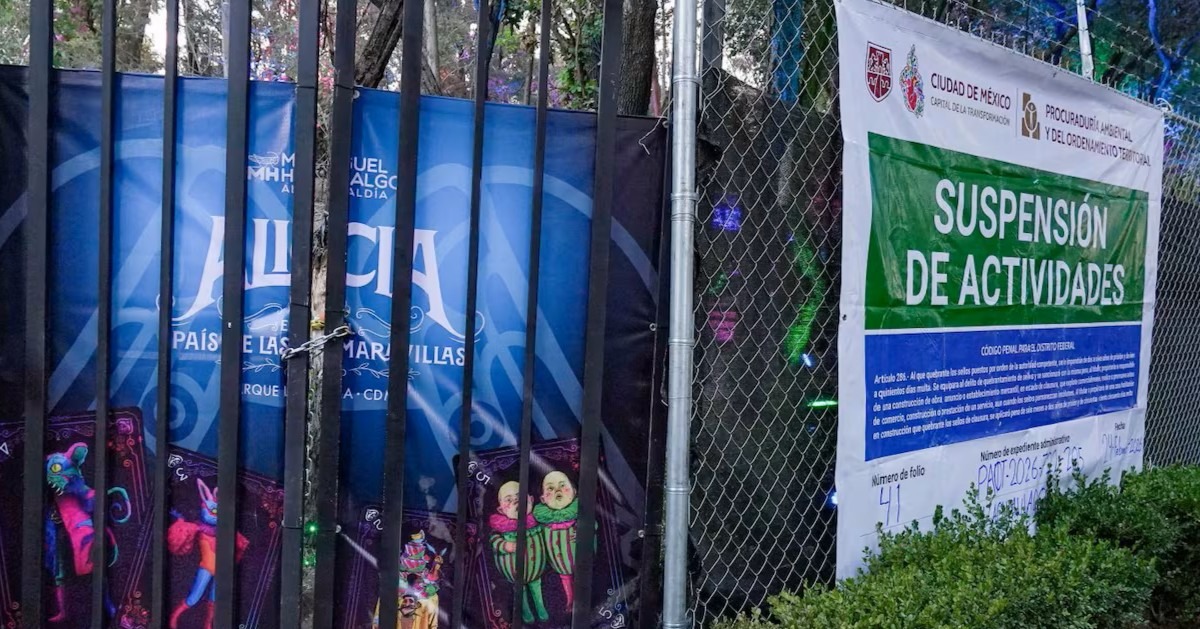
Residents and local community representatives had been objecting to the project for weeks before the court order. Their complaints centered on three broad issues. The first was public access. According to court-related reports, neighbors said most of the park had been closed off by fencing and barriers, leaving people without normal access to a public space used for recreation and daily passage.
The second issue was the condition of the park itself. Complaints pointed to alleged impacts on trees, green areas, and urban wildlife. These concerns became more serious because the dispute involved a park that is not only a recreational space, but also part of a historically important area of the city.
The third issue was the legal basis for the project. Residents questioned whether the event had all the required approvals and whether a private immersive show was appropriate in that location. Those questions had already drawn the attention of city oversight agencies before the court stepped in.
The permitting dispute started earlier
The suspension ordered this week did not come out of nowhere. In late February, the Procuraduría Ambiental y del Ordenamiento Territorial, or PAOT, said it had placed suspension seals on work at Parque Lira after receiving citizen complaints. The agency said the organizer did not present all necessary authorizations or proof that required requests had been filed.
That earlier intervention is important because it shows the dispute had already reached the environmental and land-use review stage before the court ruling. In other words, this was not just a last-minute neighborhood protest. It had already become a matter involving permitting, environmental oversight, and public-space regulation.
Reports on the case said the company behind the project faced questions related to land use, construction, green-area intervention, public spectacles, and cultural or patrimonial considerations. Those issues are especially sensitive in older parts of Mexico City, where historical character and public use often shape what can be built, installed, or commercialized.
What the court order means
The ruling reported on Thursday ordered an immediate halt to work connected to the attraction. It also barred the installation of fencing or enclosures that would block free access to the park. That matters because residents’ central complaint was that a public area had effectively been turned into a controlled event venue.
This type of court action does not necessarily decide the entire case on the merits. Instead, it freezes the situation while the legal process continues. Even so, it can have major practical effects. Once work stops and the project’s basis is under legal review, organizers may decide that moving forward is no longer viable.
That appears to be what happened here. By Friday, city authorities and news reports said the suspension seals had been temporarily lifted to allow the removal of structures and event materials from the park. Other reports said the organizer had backed away from continuing with the project because it was no longer feasible to complete the needed procedures.
The political fight around the park
The court order also became part of a wider political clash in Mexico City. Miguel Hidalgo Mayor Mauricio Tabe said the show had been presented as a cultural and family-oriented project that could bring economic activity and improvements to the area. He argued that the cancellation sent a bad signal for investment and community programming.
Opponents framed the issue very differently. For them, the case was about privatization of public space, or at least the temporary conversion of a shared park into a ticketed event site. Some residents and lawmakers also tied the dispute to earlier protests over the park’s closure and management.
That conflict reflects a broader pattern in Mexico City. Public spaces are often expected to serve many functions at once. They are green areas, community gathering places, cultural venues, transit corridors, and symbols of neighborhood identity. When governments or private organizers try to introduce a commercial event into one of those spaces, even temporarily, the question quickly becomes who benefits and who loses access.
Why Parque Lira matters
For international readers, Parque Lira may seem like a small local park dispute. In practice, it carries more weight. The park sits in a historic area near Tacubaya and is part of a site with a long history tied to old estates and later public use. That history helps explain why residents reacted strongly to the installation of barriers and temporary event infrastructure.
In dense parts of Mexico City, public parks are not interchangeable. They are often limited in number and heavily used. A closure that affects most of a park can disrupt daily routines, reduce open access, and sharpen long-running concerns about how urban land is managed. That is one reason neighborhood fights over parks, trees, and temporary constructions often become major local stories.
The Parque Lira case also speaks to a broader issue many readers in Mexico will recognize. Cities often promote cultural events, tourism, and economic activity in public areas. Residents may support those goals in theory but oppose them when they believe public land is being used in ways that restrict everyday access or bypass proper review.
What happens next
The immediate result is that the Alice in Wonderland installation at Parque Lira has been halted, and the structures associated with the event are being removed. The legal and political dispute, however, is not over. Residents are likely to keep pressing for full reopening and continued oversight of how the park is managed. Local authorities will still have to answer questions about the approvals that were granted, requested, or missing.
The case may also have consequences beyond one neighborhood. It is a reminder that in Mexico City, cultural projects in public spaces can trigger scrutiny from residents, environmental agencies, courts, and political actors all at once. For officials and organizers, the message is straightforward. If access, permits, and transparency are in doubt, even a high-profile family attraction can be stopped before it opens.