A new Defense report delivered to Congress does more than count seized guns. It traces how weapons from the United States keep moving through Mexico on at least 11 active corridors, reaching border cities, industrial hubs, Pacific ports, and southern states. For international readers, the finding matters because it turns a familiar border issue into a national map of supply, distribution, and criminal reach. It also shows why gun trafficking remains central to Mexico’s security talks with Washington.
A Defense Secretariat report says Mexico still faces 11 active gun trafficking routes from the United States. The document covers May 20 to November 19, 2025. It describes corridors that begin in Texas, Arizona, and California and extend deep into Mexico. Some reach Mexico City, Guadalajara, Guanajuato, Acapulco, Oaxaca, and Tuxtla Gutiérrez.
The report shifts the discussion away from isolated seizures. It presents gun trafficking as a distribution network with national reach. The document says the routes were identified through gun seizures and information shared through eTrace, the U.S. tracing system used by the ATF. That suggests the map reflects repeated patterns, not a single case.
A route map that runs well past the border
Several corridors described by the Defense show how quickly a border crossing becomes an inland supply line. One route runs from Brownsville to Matamoros and then toward Chiapas, with distribution points in Tampico, Tuxpan, Veracruz, and Coatzacoalcos. Another begins in McAllen and moves through Reynosa toward Oaxaca. A Pacific corridor starts in San Diego and reaches Acapulco after passing through Culiacán, Tepic, and Manzanillo.
Other routes move through the north and the Bajío. The report describes a corridor from El Paso to Ciudad Juárez and then to Guanajuato. Another starts in Laredo, crosses at Nuevo Laredo, and continues toward Mexico City. Arizona-based branches also push weapons toward Guadalajara, Los Mochis, Hermosillo, and San Luis Río Colorado.
For readers outside Mexico, the key point is simple. These are not only entry routes. They are inland corridors that connect border cities with highways, ports, and urban markets. That matters because organized crime does not rely on a single giant pipeline. It depends on a network that can keep weapons moving even when one route is disrupted.
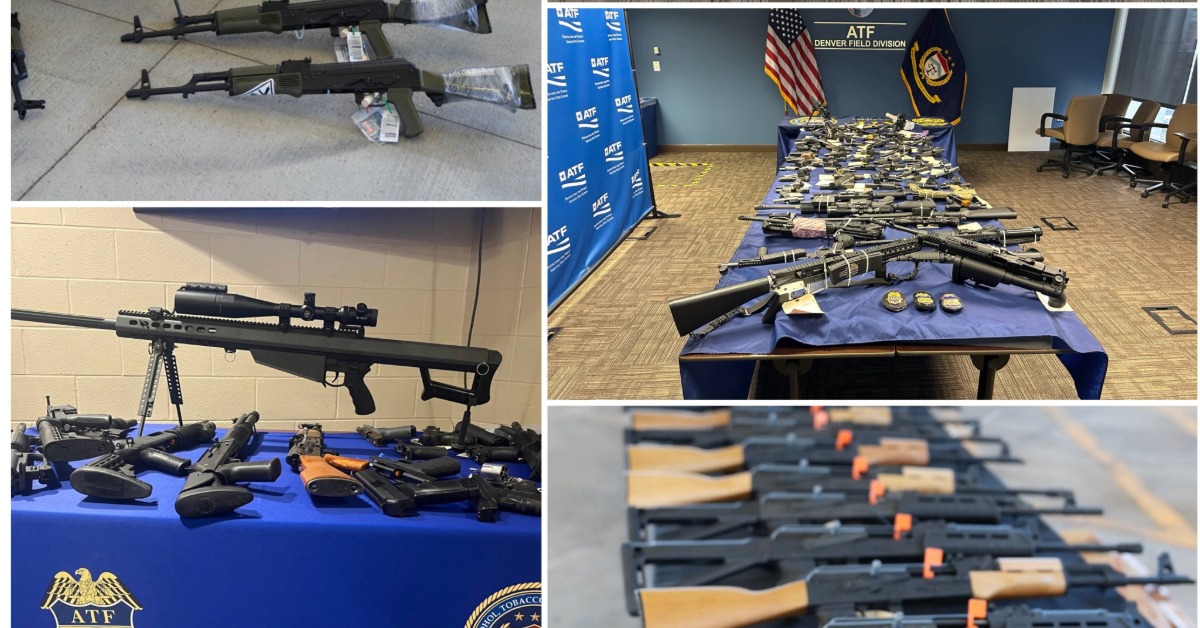
The same report says authorities seized 6,496 firearms during the six-month period. Among the calibers highlighted were 7.62 mm, 9 mm, and .50 caliber weapons. Those figures show enforcement pressure. They also show scale. Mexico is intercepting thousands of guns and still describes a corridor system that remains active.
How the report fits the wider U.S.-Mexico picture
The Mexican findings align with broader U.S. tracing data. According to ATF figures, 25,884 firearms recovered in Mexico were submitted for tracing in 2024. Of those, 70.5 percent were determined to be U.S.-sourced. Among the U.S.-sourced guns, 60.6 percent were traced to a retail purchaser in the United States. The same dataset shows pistols as the largest category, while rifles made up a large share.
That tracing data needs one caution. It is not a census of every gun used in crime in Mexico. It reflects weapons recovered in Mexico and submitted to the ATF for tracing. Even so, it remains one of the clearest official windows into origin patterns. And those patterns closely match the routes described by Defense.
U.S. Justice Department findings released earlier point in the same direction. In 2023, the largest shares of traced crime guns recovered in Mexico came from Texas, Arizona, and California. The department also said five pipelines accounted for nearly a third of recovered crime guns traced to a purchaser. Arizona to Sonora was described as the most dominant. A related finding was that 82 percent of traced Mexico crime guns were recovered in states where the Sinaloa Cartel or CJNG had a dominant presence.
Recent U.S. enforcement figures add another layer. In February, the ATF said it had seized 4,359 firearms bound for Mexico since January 20, 2025. It also reported 648,975 rounds of ammunition tied to southbound trafficking. Those figures show U.S. enforcement activity. But the Mexican report makes a different point. Seizures may be rising, yet the corridor system remains in place.
Why this remains difficult to stop
Part of the challenge is structural. In Mexico, lawful civilian access to firearms is tightly regulated. Buyers need a Defense authorization, and weapons must be registered. In the United States, the legal retail market is much larger. Investigators in both countries have long argued that traffickers exploit that gap through straw purchases, resale, theft, and fragmented transport. Once weapons cross the border, they can move through the same logistics space used for many other illegal markets.
The geography also helps explain why this issue remains central to security policy. Corridors tied to Sonora, Sinaloa, Tamaulipas, Nuevo León, Jalisco, and the Bajío intersect with regions contested or controlled by major criminal organizations. The new route map does not assign a cartel to every corridor. It does show how weapons can be moved toward the places where firepower shapes territorial control, extortion, and lethal violence.
The report also falls into a broader legal fight. In June 2025, the U.S. Supreme Court dismissed Mexico’s lawsuit against major gun manufacturers. Mexico had already filed a separate case in Arizona in 2022 against gun dealers. That context matters because route maps like this one are not only intelligence products. They also fit Mexico’s broader argument that the gun trade is organized, persistent, and cross-border.
The main takeaway from the new report is not just that guns cross the border. It is that Mexico is now publicly describing a corridor system with named cities, repeated patterns, and national reach. That makes the problem harder to dismiss as isolated smuggling. It also raises another question for both governments: whether they are only intercepting the flow, or beginning to reduce it at the source.
With information from ATF, Firearms Trace Data: Mexico, U.S. Department of Justice