
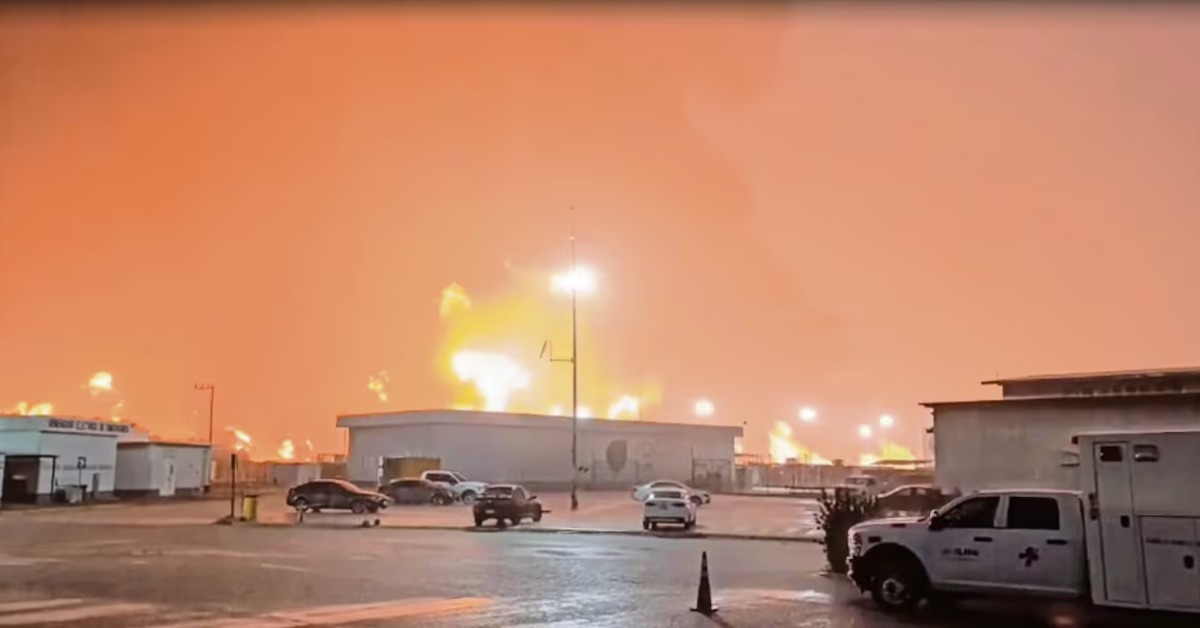
Five people died after a fire broke out near the Olmeca refinery in Dos Bocas, one of Mexico’s largest energy projects. Pemex says the blaze started after heavy rain pushed oily water outside the facility, where it later ignited. The company says operations continue normally, but the accident leaves major questions about industrial safety, drainage, and emergency controls. For readers outside Mexico, the story is bigger than one fire. It touches fuel policy, public spending, and confidence in a refinery built to reduce imports.
What happened at Dos Bocas
The fire at the Olmeca refinery began around 6 a.m. Tuesday. It was reported near the hydrocarbon storage lot 1 in Dos Bocas, Tabasco. Pemex, Mexico’s state oil company, said early findings indicate an overflow of oily water following torrential rain and flooding. The liquid pooled outside the fence and later ignited. By the end of the day, the company had confirmed five deaths. Pemex said the blaze was controlled and did not damage refinery infrastructure. It also said operations continued normally and that there was no broader risk to workers or nearby residents.
Pemex later said one of the dead was a company worker. The other four worked for an outside service company. Pemex said they were traveling in a vehicle on a federal road beside the refinery. The fire reached them there. Pemex also said injured people were receiving care, though it did not publicly give a number. That detail matters because the incident appears to have unfolded outside the main processing units, not in the plant’s core. The precise cause, however, remains under investigation.
Why the Olmeca refinery matters
For many international readers, Olmeca, also known as Dos Bocas, needs context. The refinery sits in Paraíso, Tabasco, on Mexico’s Gulf coast. It is one of the country’s newest refining complexes and a key part of the federal push to process more fuel at home. Pemex began fuel production there in 2024 and says the site was built to process up to 340,000 barrels a day. That made the project central to Mexico’s effort to cut dependence on imported gasoline and diesel.
That is why the fire quickly became a national story. The refinery has carried political and financial weight since construction began. It was presented as a step toward greater energy self-sufficiency. But the project has also faced delays, cost overruns, and operating problems during its ramp-up. Even when a fire happens outside the fence, the event is not treated as only local news. It becomes a test of confidence in one of Mexico’s most visible energy projects.
What investigators will need to answer
The main question now is not only how the fire started. It is also why oily water was able to collect outside the perimeter. Pemex’s preliminary explanation points to exceptional rain and flooding. Investigators will still need to examine drainage, containment, and monitoring systems. They will also need to establish whether the people who died were caught in a sudden chain of events or exposed to a preventable risk. Those answers matter for workers, contractors, nearby communities, and regulators.
The timing adds to the scrutiny. Just over a month earlier, another deadly Pemex accident drew national attention. On February 10, three workers died after an explosion in the Nuevo Teapa-Salina Cruz pipeline in Oaxaca during maintenance work. Taken together, the incidents are likely to deepen questions about industrial safety across Pemex operations. That does not prove a shared cause. But it makes each new accident harder to view in isolation.
For readers living in Mexico, including many foreigners who follow the country through fuel prices, utilities, and public policy, the story matters beyond Tabasco. Pemex remains central to the national economy and to the government’s energy strategy. Trouble at a flagship refinery can affect confidence, political messaging, and debate over how Mexico manages risk in strategic industries. At this stage, Pemex says operations remain normal. The larger test will be whether the investigation produces a clear explanation, public accountability, and evidence that the conditions behind the fire have been corrected.
With information from Pemex