
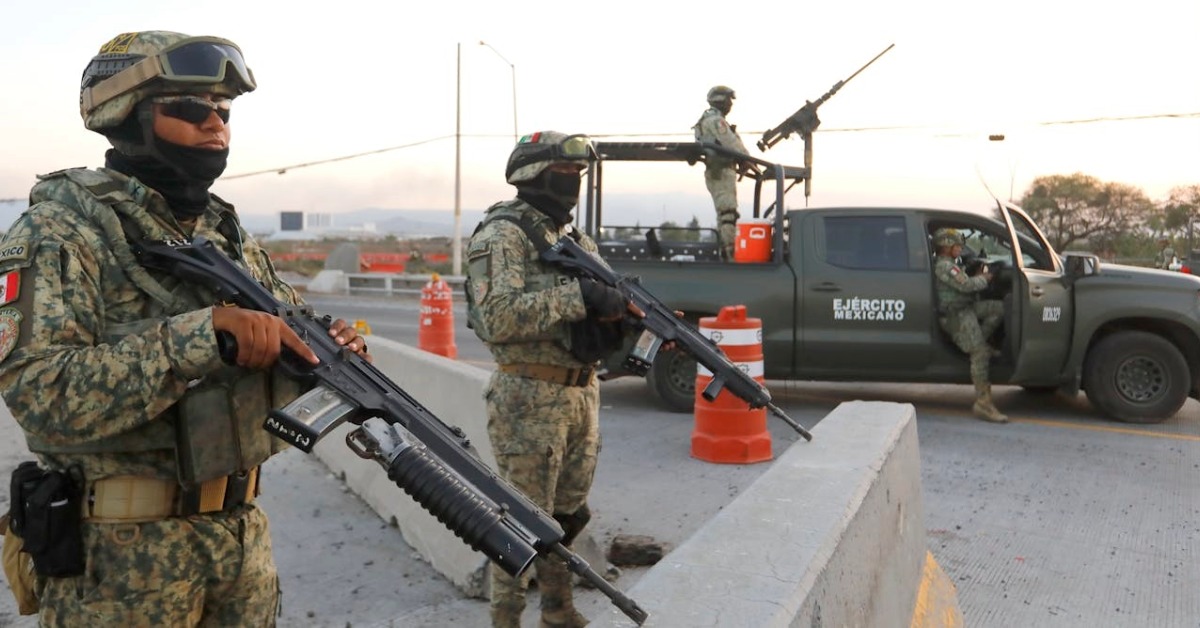
Every spike in cross-border security tension follows a script. Washington drifts toward “cartel war” language, and Mexico answers with sovereignty. The argument sounds legal, but it runs on incentives. Both governments want results, but each faces different political risks at home. The practical question is narrower: when troop talk is off the table, what cooperation still moves the needle? This explainer breaks down the parts of the bargain that can be measured—weapons, money, ports, and intelligence—and shows where the debate keeps getting stuck.
The sovereignty bargain
Every few months, the same dispute returns in U.S.–Mexico security policy. Some U.S. officials revive the idea of using force against cartels. Mexico responds with a firm constraint that is also a political identity: sovereignty. The latest round began after the promotion of a new regional “Shield of the Americas” coalition focused on cartels. Mexico’s president rejected any idea of foreign troops operating in Mexico. She also redirected the argument toward a narrower target that can be counted: U.S.-to-Mexico weapons trafficking. If high-powered firearms and ammunition stop moving south, cartel violence becomes harder to sustain. The U.S. government has supplied fresh numbers that make the point concrete. In a February 2026 release, said thousands of seized firearms and hundreds of thousands of ammunition rounds were “bound for Mexico.” The core question is not whether intervention is legal. It is what cooperation looks like when both countries want results, but neither wants the political costs of deeper intrusion.
The reason the argument persists is that cooperation is already extensive, but it is often indirect. The U.S. can tighten enforcement on its side of the border, disrupt supply networks, and prosecute trafficking cases under U.S. law. Mexico can seize weapons, arrest operators, and prosecute crimes under Mexican law. The bargain is that each government retains formal control of coercive power within its territory, while sharing enough information to make the other side more effective. That bargain is fragile because results are hard to attribute. When murders fall in one region, attribution is contested. When seizures rise, it can mean better enforcement or growing flows. The political reward for steady coordination is limited, while the political punishment for perceived subordination can be severe. That is why moments of frustration tend to produce large, symbolic proposals, including talk of direct action. It is also why Mexico’s response often focuses on inputs that the U.S. controls, such as southbound weapons and financial channels. In practice, the most stable path is to treat sovereignty as a design constraint, not a slogan, and then build programs that can survive election cycles in both countries.
Why the debate keeps sliding toward “intervention”
Intervention talk is partly a product of mismatched timelines. The U.S. political system rewards visible action and fast claims. Mexico’s security problem is long-running and local, and its solutions are slow to take effect. When U.S. leaders describe cartels as a military enemy, the language implies battlefield tools and battlefield permissions. That framing breaks quickly in Mexico, where national memory includes episodes of foreign pressure and long-standing suspicion of external control. It also breaks because cartels are not only armed groups. They are also business networks that rely on logistics, finance, and corruption. A military frame can absorb those realities, but it tends to prioritize raids and decapitation. That emphasis creates a cycle: tactical wins, adaptation, and renewed calls for harsher measures. The result is a debate that feels binary, even though the real choices are mostly administrative. How many outbound inspections occur? How many straw purchasers are prosecuted? How often do investigators share trace results quickly enough to stop a second shipment? Those questions rarely dominate the public debate, but they determine whether cooperation yields durable outcomes.
Mexico’s legal structure also forces the conversation into “permission” language. In the Mexican constitution, the Senate has exclusive authority to authorize the federal executive to allow the passage of foreign troops through the country and to allow foreign troops to remain in Mexican waters for more than a month. That is not an academic point. It shapes what Mexico’s government can accept without appearing to surrender control, even when the assistance offered is training or intelligence support. Mexico has also tightened the rules governing foreign law enforcement and security agents, requiring formal channels and documentation for cooperation. These rules reflect genuine concerns about accountability, leaks, and domestic legitimacy. They also slow joint work, particularly when cases involve sensitive sources. The result is a predictable pattern: the United States pushes for faster, more direct action, while Mexico insists on process and control. The practical solution is not to ignore those constraints, but to build cooperation that works within them.
Guns are the most measurable battlefield
The strongest “actionable” argument in this week’s exchange is about weapons because the chain of responsibility is clearer. Mexico has strict civilian gun access and a limited legal market, while U.S. retail access is broader and geographically closer to trafficking routes. That does not mean every firearm used in Mexico originates in the United States. It does mean the U.S. is positioned to influence supply, pricing, and availability for traffickers. The February 2026 release is notable because it presents specific counts and a time window. The figures cover seizures since January 20, 2025, and include a subset identified as “bound for Mexico.” Numbers like these matter because they can anchor a bilateral target. If seizures rise because enforcement improves, the next question is whether prosecutions rise and whether networks are dismantled. If seizures rise but trafficking adapts quickly, the question shifts to where the system is porous: gun shows, private sales, corrupt brokers, or border inspection gaps. In other words, weapon counts are not the finish line. They are a way to move the conversation from ideology to operational design.
A realistic firearms strategy also has to respect the limits of the data. Gun “tracing” only works when Mexico recovers guns, preserves identifiers, and submits them for tracing. That process is uneven across states and agencies. It is also shaped by investigative priorities. A trace dataset can overrepresent certain weapon types or regions, and it can miss weapons diverted through theft, secondary markets, or non-reporting jurisdictions. Even so, tracing is one of the few tools that can connect a shooting scene in Mexico to a retail sale in the United States. That connection is what allows investigators to identify recurring dealers, straw purchasers, and corridors. This is where sovereignty and effectiveness can align. The U.S. can intensify investigations and prosecutions on U.S. soil. Mexico can use trace outputs to build cases inside Mexico. The shared task is to standardize what gets traced, shorten delays, and treat ammunition as seriously as firearms, because ammunition flows can reveal high-volume supply lines.
What works on guns without crossing sovereignty lines
The practical agenda on guns is built from boring steps that add up. The first is increasing southbound inspections at ports of entry and building a routine expectation that outbound vehicles may be checked. The point is not to search everyone. The point is to raise the risk for traffickers who depend on repetition and predictability. The second is targeting purchasing behavior. Straw purchasing networks rely on people who can buy legally, buy repeatedly, and then transfer guns to traffickers. These cases can be prosecuted in the U.S. without any foreign presence in Mexico. The third is improving the handoff between seizures and prosecutions. A seizure that does not lead to dismantling a supplier network is a temporary disruption. A seizure tied to financial records, communications, and trace results can become a case that removes a broker from the market. The fourth is expanding standardized tracing and ballistic imaging inside Mexico, so that Mexico’s investigators can connect weapons to crimes across jurisdictions. That makes cartel “kits” harder to reuse and harder to conceal.
Recent bilateral initiatives point toward this model. The U.S. and Mexico have created formats to enable real-time information sharing, joint planning, and the expanded use of tracing tools across Mexican states. For readers who live in Mexico, this is the part of cooperation that is most likely to affect day-to-day security over time, because it targets the tools that enable intimidation, territorial control, and rapid escalation. It also avoids the most politically toxic symbol: the presence of foreign troops. The trade-off is patience. A firearms strategy is not a single operation. It is a sustained administrative push that will be judged by changes in weapon availability, the price of illicit firearms, and the frequency of high-powered attacks. Those outcomes are slower to measure than a raid, but they are more compatible with the sovereignty bargain that Mexico’s government insists on keeping.
Money is the second border
If guns are the most visible input, money is the most decisive enabler. Cartels pay for weapons, recruits, transport, bribery, and precursor chemicals. They also need to convert proceeds into assets that can survive arrests and seizures. This creates a second border that runs through banks, money transmitters, trade finance, cash-intensive businesses, and informal value transfer systems. It is also where cooperation can degrade into accusations. The U.S. often wants faster, more aggressive action against financial facilitators, including institutions that touch U.S. correspondent banking. Mexico often demands evidence that meets Mexican legal standards, and it resists measures that appear to be external policing of its financial sector. The actionable path is to treat financial disruption as an engineering problem. Focus on high-volume nodes. Share typologies. Use matched timelines for investigative steps. Make it easier for Mexico’s financial intelligence and prosecutors to turn U.S. leads into Mexican cases, and vice versa.
Recent U.S. guidance has highlighted money-laundering networks that connect cartel proceeds to international supply chains, including payments to chemical suppliers. Those documents matter for bilateral cooperation because they include red flags that compliant institutions can act on. They also matter because they shift pressure away from symbolic troop talk and toward tools the U.S. can apply unilaterally inside its own financial system. For Mexico, the priority is to build cases that survive in court and impose visible penalties on facilitators, not only traffickers. For expats, the relevance is indirect but real. Financial enforcement can touch industries that intersect with local economies, including real estate and hospitality, because those sectors can be attractive for laundering. The goal is not broad suspicion. The goal is targeted disruption of known typologies and repeat facilitators.
What is actionable on money without destabilizing cooperation
Effective financial cooperation starts with shared definitions of success. The metric is not the number of accounts flagged. The metric is whether major facilitators are removed, whether illicit transfers become more expensive and slower, and whether cartel organizations have less flexibility to replace seized shipments. That requires both countries to treat information sharing as operational rather than diplomatic. It means sharing the parts of a case that can be shared, early enough to matter. It also means protecting sensitive sources through structured channels, so that intelligence can be used without being exposed broadly. This is where sovereignty concerns are predictable. Mexico will resist any mechanism that would allow foreign agents to directly steer domestic enforcement. The workaround is to jointly target cells that agree on priorities, then split execution by jurisdiction. The U.S. executes U.S. warrants, seizures, and regulatory actions. Mexico executes Mexican investigations and prosecutions. The deliverable is a synchronized timeline, not a shared badge.
A second actionable step is linking money cases to logistics cases. A port seizure becomes stronger when it ties to a payment chain. A weapons seizure becomes stronger when it ties to a broker’s finances. This is also where public transparency can help. When either government announces sanctions or enforcement actions, the credibility of the claim improves if the public can see clear categories of conduct, case examples, and legal outcomes. That does not require disclosing sensitive details. It requires publishing enough to show that enforcement is not symbolic. The political benefit is that it reduces pressure for military rhetoric, as it gives both governments a way to show progress without involving foreign troops. Financial disruption is not a substitute for policing. It is a way to shrink cartels’ operating capacity while preserving the sovereignty bargain.
Ports, precursors, and the logistics reality
Ports are where the supply chain tests the sovereignty bargain. Much of the violence associated with cartels is downstream from logistics: the movement of drugs north, weapons south, and money through formal and informal channels. The chemical side is central because synthetic drug production relies on industrial inputs that move as legitimate cargo until they are diverted. Mexico’s Pacific ports have long been focal points for this problem, especially for precursor chemicals that can be used in methamphetamine production and related supply chains. Mexico’s navy has described large-scale interdictions in maritime, air, and land operations, including seizures and neutralization of chemical precursors. Port enforcement can produce large headline numbers, but its real value is in reducing the predictability of import routes and increasing the cost of diversion for criminal networks.
A port strategy also forces a more honest division of labor. The U.S. is positioned to target shipping intelligence, sanctions, and financial facilitators linked to import networks. Mexico is positioned to inspect containers, arrest on-site operators, and prosecute corruption cases tied to ports and customs. Neither side can fully solve the problem alone. If Mexico tightens port inspections without corresponding international targeting, networks may shift suppliers and routes. If the U.S. focuses only on overseas suppliers without container-level enforcement and corruption control in Mexico, diversion continues. This is the kind of cooperation that is politically easier than troop deployment, but operationally demanding. It requires data systems, vetted units, and consistent follow-through in court.
Border infrastructure and intelligence without occupation
Intelligence sharing is the least visible element of the sovereignty bargain, and often the most important. It is also the easiest to politicize. When intelligence cooperation is perceived as domination, Mexico pays a legitimacy cost. When it is perceived as unreliable or leaky, the U.S. reduces what it shares. The practical compromise is to build well-defined channels tied to specific missions. A mission can be “stop southbound weapons shipments,” “identify high-risk cargo,” or “target money laundering nodes.” Each mission can have a shared playbook, a narrow group of participants, and clear rules for documenting interactions and protecting information. That design reduces the risk that intelligence sharing turns into an implicit endorsement of foreign control.
Recent bilateral formats have tried to move in this direction, including mechanisms that emphasize real-time information sharing and coordinated inspections while keeping enforcement authority on each side of the border. The broader point is that intelligence does not need a foreign troop footprint to be operational. It needs speed, standard formats, and common targets. The U.S. can contribute technical capabilities and investigative reach. Mexico can contribute jurisdictional access and the ability to act quickly on the ground. Successful intelligence cooperation also requires restraint in public messaging. When one side frames cooperation as a military coalition, the other side is incentivized to publicly reject it, even if quiet coordination continues. That is why the “sovereignty bargain” is partly about language. It is also about building systems that survive political cycles.
What progress looks like for readers living in Mexico
For residents and expats in Mexico, the most useful way to read the sovereignty debate is as a competition between two kinds of metrics. One kind is symbolic: announcements, labels, and promises of force. The other kind is operational: seizures tied to prosecutions, reduced access to high-powered weapons, and disrupted supply chains. The operational metrics can be imperfect, but they are trackable. On guns, look for sustained increases in U.S. investigations and prosecutions tied to trafficking networks, and for faster tracing cycles that identify repeat sources. On money, look for actions that isolate known facilitators from the financial system and produce court outcomes, not only designations. On ports, look for sustained inspection capacity, corruption cases that result in convictions, and measurable disruption of precursor shipments. On violence, use Mexico’s national crime registry as a baseline, while keeping in mind that it reflects cases opened by prosecutors and can shift with reporting practices.
The sovereignty bargain will continue to produce rhetoric because it is useful politics in both countries. The actionable agenda is quieter. It lives in guns, money, ports, and intelligence. It also lives in the discipline to treat those areas as a joint systems problem, not a contest over pride. The most stable form of cooperation is the one that lets each government show results without appearing to cede control. That is not idealism. It is the only model that has a realistic chance of lasting.