
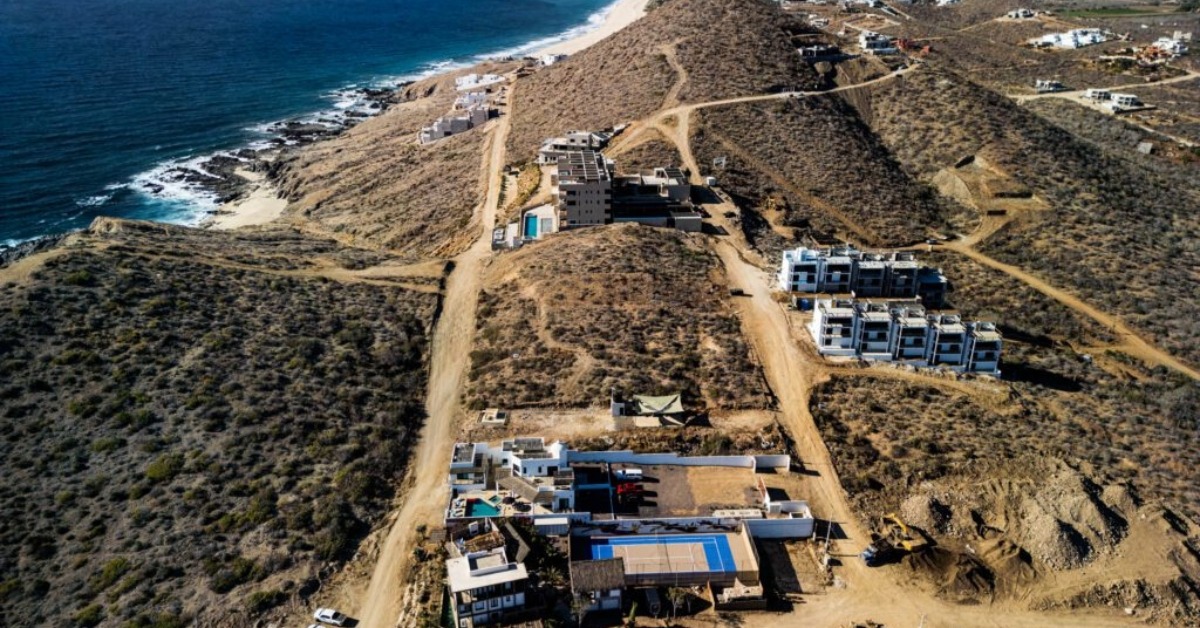
Los Cabos was supposed to be an early showcase for Mexico’s new housing push. Instead, the project is running into one of the region’s oldest problems: land that costs far more than national housing formulas were built to handle. Officials say the program is moving, with the first homes nearing delivery, but the bigger question is whether affordable housing can scale in one of Mexico’s fastest-growing and most expensive markets, where demand, tourism, and urban growth continue to push land values higher.
A national plan meets local prices
Mexico’s public housing push is running into a local constraint in Los Cabos: the price of land. Local officials say the federal program can move forward. They also say it cannot work under the same assumptions used in cheaper markets. The problem is not demand. Authorities have marked Los Cabos as a major piece of the housing plan in Baja California Sur. The long-term target is 17,400 homes in the municipality. The problem is whether enough land can be assembled at prices that still make social housing viable. That matters because the gap between policy targets and market prices can slow construction. It can do so long before a family gets keys. It also helps explain why a program meant to expand lower-cost housing faces a tougher path here. Los Cabos is one of Baja California Sur’s fastest-growing areas. In practical terms, the issue is not whether the need exists. It is whether the government can secure land, extend services, and keep the final housing product within reach of lower-income households.
Why Los Cabos is harder than most markets
The challenge is bigger than one project. The Los Cabos municipal development plan describes a housing market under pressure. It points to fast growth, rising prices, and limited room for lower-cost development. The document says home prices in the municipality rose 17.7 percent in the first quarter of 2023. It links that rise to higher construction costs and strong demand. It also points to a lack of developers focused on vivienda de interés social. Another problem is the difficulty of building a sufficient territorial reserve. The same plan points to thousands of homes inside irregular settlements in Cabo San Lucas and San José del Cabo. That shows the housing problem is not limited to future buyers. It is already part of the current urban landscape. That is why the land-cost issue matters beyond one announcement. In a market shaped by tourism, population growth, and urban expansion, cheaper land is harder to find. Each delay in land assembly can push affordable housing farther from jobs, infrastructure, and daily services.
Progress is real, but scale remains the issue
There is still visible progress. Municipal authorities have said the first 96 homes are essentially finished. They only need the final sanitary infrastructure and drainage connections before delivery. Officials have also said the first stage in Los Cabos includes 704 homes nearing completion. Even so, the broader state goal remains much larger. At the state level, authorities say local governments proposed 10 parcels covering about 87 hectares. Those sites would allow the construction of 4,454 homes. That shows the program is not stalled. It also shows something more specific. Delivery at small scale is possible. Scaling up to the full promise will require more than construction crews and financing. It will require land that can be acquired, serviced, and permitted without driving costs beyond the program’s purpose. In Los Cabos, real estate values are pushed by sustained demand and limited supply. That may make land assembly the hardest part of the entire housing agenda.
Why this matters for the city
For residents, this story is about more than one headline. It is about what kind of city Los Cabos becomes over the next several years. A housing program can announce large targets. The real test is whether workers can live within a reasonable distance of the places that depend on them. When land costs stay high, lower-cost housing often arrives more slowly. It can also end up farther from core areas. In some cases, it appears in smaller phases than expected. That can add pressure to mobility, services, and informal growth. None of that means the federal plan is failing. It means public housing in Los Cabos is confronting the same market conditions that have shaped the area for years. The first deliveries may show the model can work. The harder question is whether officials can adapt national housing rules to local price levels quickly enough. That is what would turn an initial rollout into a durable answer.