
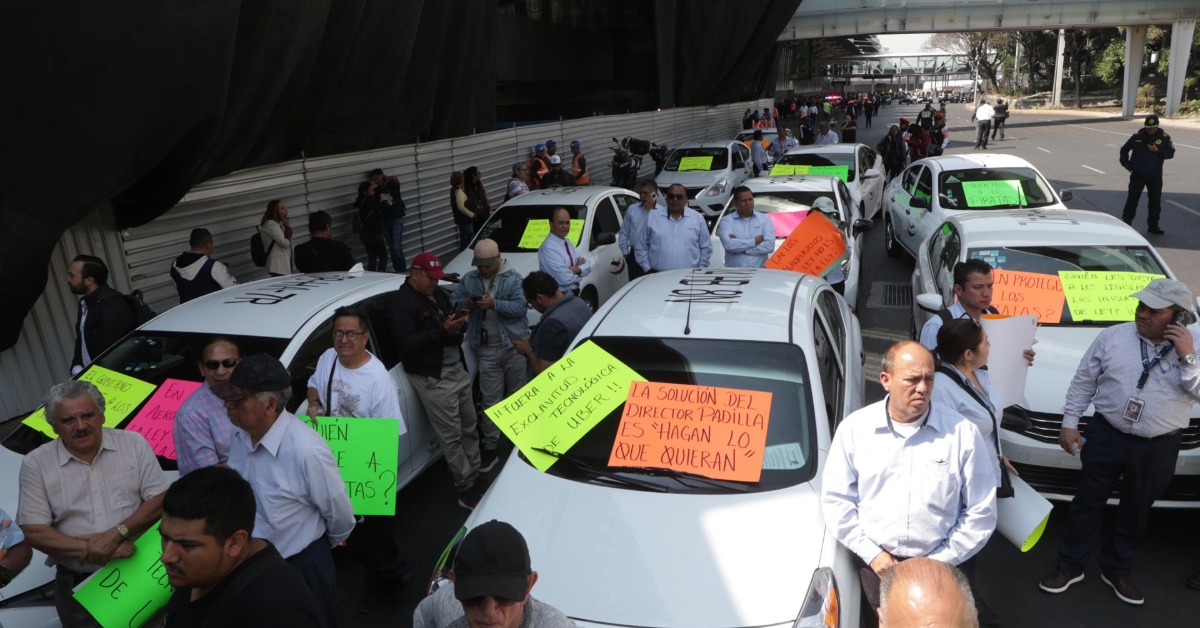
A protest by licensed airport taxi operators has pushed Mexico City’s airport back into a long-running fight over Uber and other app pickups. Officials now say the National Guard will tighten enforcement inside the airport, while Uber points to a court order it says protects its drivers. For travelers, especially foreign visitors arriving with luggage and little local context, the dispute is more than a turf battle. It could shape how easily, safely, and affordably they leave the airport in the weeks ahead.
After the blockade, officials moved fast
The standoff over Uber pickups at Mexico City’s airport shifted sharply after taxi operators blocked access roads to the capital’s main air hub. What had been an unstable gray area quickly became a tougher enforcement issue.
Authorities and representatives of licensed airport taxi groups said the National Guard would begin operations on March 12 to stop app-based drivers from picking up passengers inside the AICM, the airport commonly known by its Spanish initials. They also said enforcement would start in phases and become permanent by March 31.
That matters because the dispute is not about whether travelers can use ride-hailing apps in Mexico City. They can. The issue is narrower and more contentious. It is about whether app drivers can legally pick up passengers inside a federal airport zone, where licensed airport taxis say they pay for rights and permits that platform drivers do not hold.
For many travelers, the policy fight only becomes visible after landing. It appears at the curb, in the pickup area, and in the cost of the ride home. After the blockade, that uncertainty became harder to ignore.
Why the fight keeps coming back
This was not a sudden clash. The dispute has been building for years and sits at the intersection of federal transportation rules, airport operations, competition, and traveler choice.
Airport taxi operators argue that the rules are clear. In their view, only authorized providers should be allowed to pick up passengers inside airport grounds. They say they pay fees, meet operating requirements, and work under a regulated structure that platforms have not matched.
The companies behind the apps see it differently. They argue that passengers should be free to choose how they leave the airport and that federal enforcement has crossed into arbitrary detention and punishment of drivers. That legal argument gained force in late 2025, when Uber won a court order that it says protects its drivers from detention while the broader case moves forward.
The government’s position has not matched Uber’s reading of that court order. Federal authorities have continued to say that the ruling does not constitute full authorization for platforms to operate within airport zones. In other words, one side says the court created temporary protection. The other says the underlying ban still stands.
That gap is why the conflict keeps returning. It is not only a market fight. It is a fight over what the law currently allows, who enforces it, and whether Mexico’s transport rules have kept pace with how people now move through major airports.
What changed for passengers
For international readers, the most important point is practical. App drop-offs and app pickups are not treated the same way. Getting dropped off at the airport is generally less controversial. The problem is getting picked up there.
That distinction has shaped the traveler experience at AICM for some time. In 2024, airport authorities pushed app pickups away from the terminal frontage and toward designated areas outside the immediate airport perimeter. That already meant some passengers had to leave the most convenient pickup areas and walk farther with bags, children, or mobility concerns.
Now the pressure is increasing again. If the new enforcement plan holds, passengers arriving at the airport may face a narrower set of choices. They may need to use an authorized airport taxi, prearranged transport, or a pickup point farther from the terminal if app services continue to operate at the edges of the airport zone.
That is one reason the story matters beyond the taxi sector. The passengers affected are not only regular Mexico City commuters. They include tourists, business travelers, returning residents, and foreign arrivals who may not know the local rules or the safest pickup options after dark.
For expats and frequent visitors, this also revives a familiar frustration. Airport taxis are regulated and readily available, but many travelers prefer platforms because they know the price upfront, can track the vehicle in the app, and have a digital record of the trip. When those options become harder to use, the trip from the airport can feel less predictable.
Sheinbaum’s response points to a compromise, not a solution
President Claudia Sheinbaum signaled on Thursday that the government understands both sides of the dispute, but her comments also showed that no lasting solution has been reached.
She said licensed airport taxi operators have a valid point when they argue that they hold the rights to operate within the airport. At the same time, she said passengers should still have a safe option to use a platform service, even if that means going to a more distant pickup area. She also said airport taxi fares should be moderated to avoid hurting users.
That sounds less like a final policy and more like a temporary balancing act. The state appears to be protecting the privileges tied to licensed airport service while also acknowledging that travelers want other options. For now, that balance still depends on physical separation, enforcement, and case-by-case tolerance.
The larger issue remains unresolved. A legislative proposal in Congress seeks to create a clearer federal framework for platform transport in airports. If lawmakers eventually act, the current mix of sanctions, court orders, and airport-by-airport improvisation could change. Until then, the conflict is likely to keep producing flare-ups.
A warning sign before a heavier travel cycle
The timing is not minor. Mexico is moving toward a busier travel period, and the country is also preparing for the 2026 World Cup, which will bring added pressure to airports, roads, and urban transport systems.
That does not mean every arriving passenger at AICM will be stranded or forced into a costly ride. But it does mean the airport remains one of the clearest examples of how Mexico’s transport rules, commercial interests, and visitor logistics are still colliding in real time.
For the government, the challenge is greater than ending a single protest. It must keep the airport operating, avoid passenger chaos, enforce federal rules, and show that Mexico can handle a major surge in visitors. For travelers, the question is simpler. When they land, they want a clear, safe, legal, and reasonably priced way to leave the airport.
This week’s events show that Mexico City still lacks a stable answer. The authorities have chosen to enforce more strongly for now. The legal battle is still open. The policy debate is still open. And for passengers at the curb, that uncertainty matters most.
With information from El País México, Gaceta Parlamentaria, Gobierno de México AICM, SICT