Today’s news agenda is split between what is happening on the streets and what is moving inside institutions. The biggest immediate factor is the International Women’s Day mobilization in the capital, with road impacts and Metro service changes that can affect errands, airport transfers, and weekend plans. Separately, the country is still absorbing the security and political aftershocks from the late-February operation that killed “El Mencho,” a turning point that has triggered renewed focus on cartel violence and on World Cup security. In the background, the next two weeks bring a defined start to the USMCA review process, while rising oil prices are testing how long authorities can shield consumers from global shocks.
Civic life and mobility in Mexico City
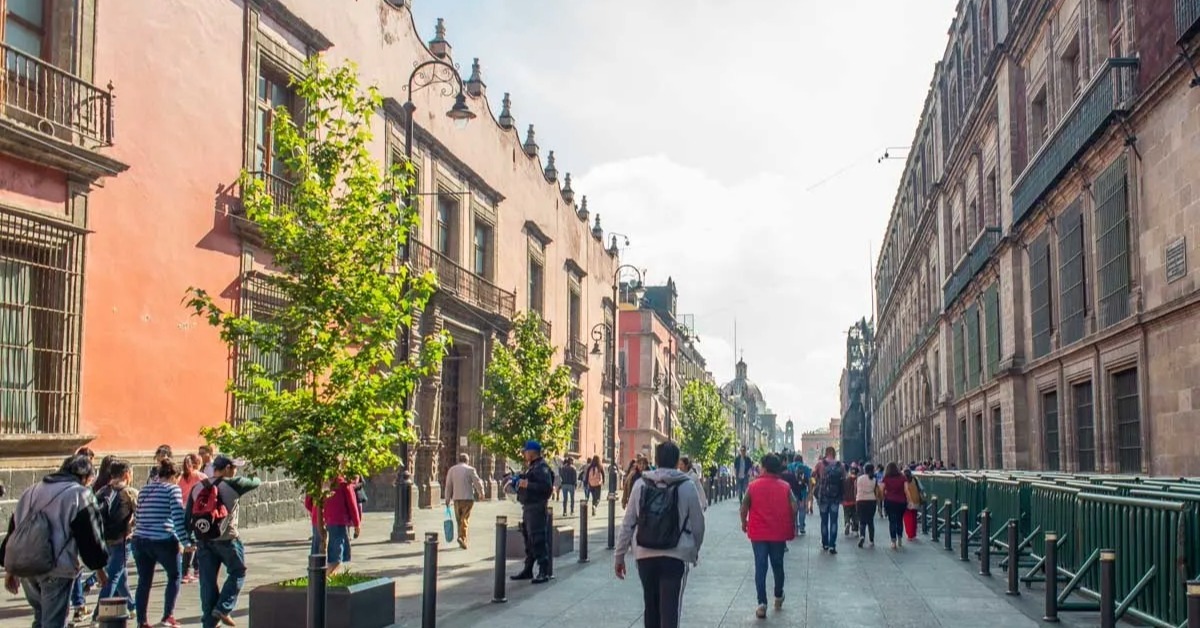
The core “what matters today” story for day-to-day life is the 8M march. Organizers have announced a general morning call time, with movement expected to build toward late morning and to funnel toward the city center. A key destination is the Zócalo, and the most widely cited route runs along Paseo de la Reforma toward downtown. In parallel, the federal government has signaled that the National Palace may again be protected by barriers, citing the goal of preventing clashes and property damage during demonstrations that have seen confrontations in prior years. For expat residents, the practical effect is simple: travel times in and around central corridors are likely to be less predictable than on a typical Sunday, especially around midday.
Public transport planning matters today almost as much as traffic planning. The Sistema de Transporte Colectivo Metro has announced station and service changes tied to the weekend’s mobilizations. Specific stations are expected to close earlier on Saturday evening and remain closed into Monday morning, and Line 2 is set to operate in segmented service on Sunday. A bus bridge is planned to cover a key gap through the Red de Transporte de Pasajeros. City officials have also described an “accompaniment” operation, including a deployment of women police officers and dedicated traffic-control teams to manage closures. Separately, for readers coordinating with family or work outside Mexico, note that the United States moves clocks forward today, while most of Mexico does not, changing the effective time difference for many cross-border calls and itineraries.
Security after Nemesio Oseguera Cervantes
The dominant national security storyline remains the aftermath of the February operation that killed Oseguera Cervantes (known as “El Mencho”), leader of the Jalisco New Generation Cartel. President Claudia Sheinbaum traveled to the western state of Jalisco to address security concerns and to project operational control in a region central to tourism and major events. The violence that followed the killing has been described as including large-scale arson and clashes, and it concentrated attention on the host-city readiness of Guadalajara. Authorities say the wave left more than 70 dead, including 25 members of the National Guard. For many residents and foreign observers, the immediate question is not only “what happened,” but also whether the state can prevent a recurrence—especially with international visitors expected for the 2026 FIFA World Cup.
Officials describe those preparations in concrete terms: a security plan involving more than 20 federal agencies, coordination with the United States, Canada, and FIFA, and joint task forces in the three Mexican host cities. The government’s messaging is being reinforced with visible “normalization” signals in the sports calendar. That includes continued World Cup-related events and public-facing statements that risks to fans are being reviewed. Still, early-March disruptions have been real: the global governing body World Aquatics canceled the early-March Diving World Cup stop in Zapopan, citing security concerns and embassy travel restrictions, and Mexico’s sports leadership said it would move into a rescheduling phase.
The security shift is also personal for Omar García Harfuch, the federal security chief closely associated with the government’s tougher anti-cartel posture. Reuters reports that Harfuch has lived under heavy protection since a 2020 assassination attempt linked to the cartel he now targets, and that the latest crackdown—while politically strengthening—has helped trigger violent retaliation and raises the risk of further cartel infighting. For expats, the operational takeaway is not that daily life everywhere changes overnight, but that security conditions can shift quickly in specific corridors or states, and major events are now tightly linked to security deployments and travel guidance.
Economy and cross-border watch
The main “calendar item” for the economy is the start of bilateral discussions tied to the USMCA review. The Office of the United States Trade Representative says U.S. and Mexican negotiators will begin talks the week of March 16, as part of the agreement’s joint review process. The stated focus includes measures intended to ensure the agreement’s benefits accrue to the three parties, including reducing reliance on imports from outside the region. Reuters also reports that the Donald Trump administration faces a July 1 deadline to notify Congress if it plans to change the agreement, and economists continue to flag downside risks tied to negotiation outcomes. In a separate Reuters poll, Mexico’s growth outlook remains modest, with economists pointing directly to uncertainty around the trade pact as a central drag factor in 2026.
Energy prices are the other high-impact economic variable today, mostly because they can reach households quickly through transport costs. El País reports that Mexico’s export crude blend closed at $70.38 per barrel, its best level since June 2025, after U.S. and Israeli attacks on Iran pushed global crude prices higher. The same report describes the president saying authorities intend to keep gasoline prices stable through subsidies, while noting typical pump prices in early March in the mid-20s pesos per liter range, depending on region. Globally, Reuters has described the Iran conflict as a driver of sharp oil price moves and shipping risk through key routes, with spillovers to fuel and transport costs. For expat households and businesses, the most relevant question is whether any price stabilization lasts, and what the fiscal tradeoffs may be if global volatility persists.
Mexico is also pushing on a cartel-linked economic problem that sits at the intersection of corruption, public revenue, and security: fuel smuggling. Reuters reports that Mexico expanded a probe into fuel smuggling at seaports, with the anti-corruption ministry overseeing internal investigations within multiple ports and also within maritime and customs bodies. The report explains how the scheme can work through falsified shipping and customs paperwork to evade taxes on imported fuels, and cites the U.S. Treasury Department’s assessment that illicit fuel and stolen crude have become a major revenue stream for cartels, second only to narcotics. This is one of the clearest examples of why today’s security agenda is not limited to gunfights and arrests; it is also about logistics networks, state oversight, and the credibility of institutions that manage trade flows.
Rule of law and accountability
A major institutional development this week, still unfolding today, is a court order tied to the long-running disappearance case involving 43 students from the Ayotzinapa Rural Teachers College in Guerrero. Reuters reports that a Mexican court ordered the military to hand over long-awaited documents after rejecting the army’s earlier position that 853 pages generated by an army intelligence agency did not exist. The decision explicitly frames access to the information as an overriding public interest, given the families’ and society’s demand to know the truth. The families’ legal representative, the Agustín Pro Human Rights Centre, welcomed the order and pointed to the obligation of the Secretariat of National Defense and other military bodies to provide key information.
The case remains a national reference point because it extends beyond a single crime scene. It tests how far the state will go to disclose records tied to alleged collusion between organized crime and local security forces, and it puts military transparency under sustained scrutiny. Reuters notes that, despite more than a decade of promises, no one has been convicted, while more than 100 arrests have led to ongoing prosecutions. The ruling does not resolve those failures on its own, but it does create a clear legal obligation to produce documents that may influence investigative direction, public confidence, and the credibility of future government commitments regarding human rights abuses.