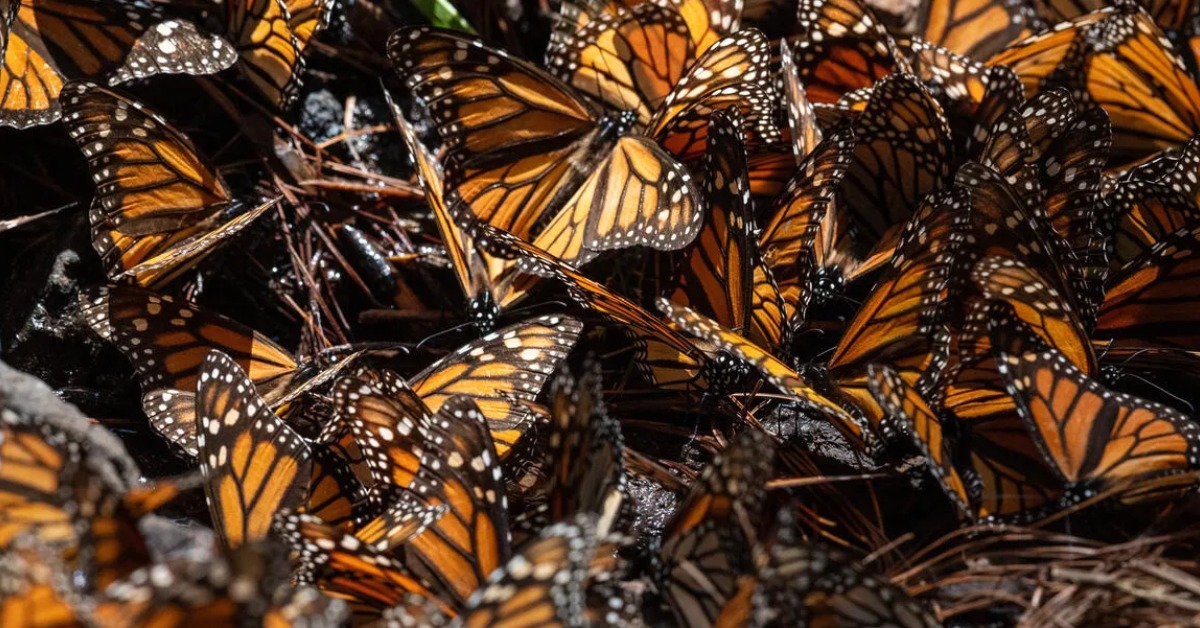
Mexico’s monarch winter colonies expanded sharply this season, offering another rare sign of improvement for a migration that has struggled for years. The number sounds straightforward, but the story behind it is not. Better weather in breeding and migration areas helped, and forest losses in the reserve core also declined. Even so, the annual survey measures occupied forest, not individual butterflies, and the species remains exposed to habitat loss, pesticides, illegal logging, and climate pressure across North America.
A rebound after two weak seasons
Mexico’s monarch butterfly colonies occupied 2.93 hectares this winter, up 64% from 1.79 hectares a year earlier. Officials said nine colonies were located in the mountain forests of Michoacán and the State of Mexico. The largest was found at El Rosario, a major sanctuary in the monarch region. The rebound follows last year’s increase after the species fell to 0.9 hectares in 2023-2024, one of the worst seasons in decades.
Officials linked part of this year’s increase to better weather in breeding and migration areas north of Mexico. Spring and summer were less dry than in 2024 in the United States, which helped produce more eggs and larvae. Drought stress was also lower during the southbound migration, leaving more flowering plants available for nectar. Even so, the new total remains far below the 18.19 hectares recorded in 1996-1997.
Why the count is measured in hectares
This annual survey is not a direct count of butterflies. Scientists visit the known winter sanctuaries after colonies settle. They then map the trees occupied by the butterflies. They use GPS and geographic analysis to calculate the area of forest occupied. That works because monarchs cluster in dense layers on oyamel fir and other high-elevation trees. Exact headcounts are impractical.
Teams surveyed 13 known sanctuaries during the season. The result announced this week covered nine colonies. Five inside the Monarch Butterfly Biosphere Reserve accounted for 2.27 hectares, while four outside it covered 0.66 hectares. That split matters because it shows the migration still depends on forests beyond the reserve’s core tourism zones. For international readers, this is the eastern migratory monarch population. It breeds in southern Canada and much of the United States, then flies about 4,000 kilometers to central Mexico each autumn.
Why the danger is not over
A better winter count does not mean the migration is secure. Monarchs still face pressure across all three countries that share this route. In breeding areas to the north, the species depends on milkweed, the plant on which it lays eggs. Herbicide use, land conversion, and the loss of nectar plants have reduced that habitat for years. Climate change adds another layer of risk by changing rainfall, temperature, and storm patterns during breeding, migration, and hibernation.
Protection inside Mexico also remains essential. A separate forest report found 2.55 hectares of damage in the reserve’s core zone between February 2024 and February 2025. That was lower than the 3.728 hectares recorded a year earlier, but it was not minor. Illegal logging remained the biggest source of loss, followed by fire and drought. Authorities also continue to flag pesticide pressure and poorly managed tourism as threats that can weaken the habitat monarchs need to survive winter nights.
Why this matters beyond the sanctuaries
For many people, the monarch is a seasonal symbol. In practical terms, the story is larger than a single species. The Monarch Butterfly Biosphere Reserve helps recharge the Cutzamala water system. That system supplies water to more than five million people in the Mexico City metropolitan area. The reserve is also a biodiversity hotspot and a UNESCO World Heritage site. When these forests are healthier, the benefits extend beyond the orange clusters tourists come to see.
That wider context helps explain why a 64% increase is welcome news, but not a final answer. Yearly monarch numbers can swing sharply with the weather. One good season can be followed by a bad one. What matters more is whether habitat protection, restoration, and cross-border cooperation can continue to raise the baseline over time. For now, Mexico’s latest count offers a documented sign of improvement. It also shows how fragile the migration remains.