
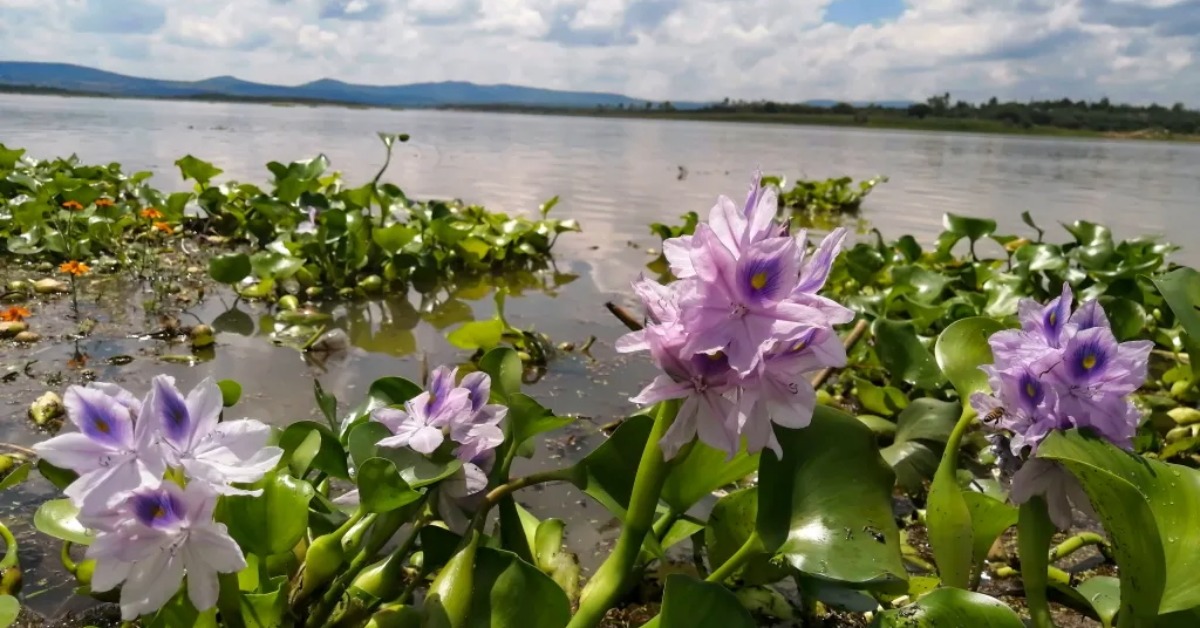
A plant that clogs Mexico’s reservoirs has become raw material in San Miguel de Allende. Near Presa Allende, Rosa María harvests invasive water hyacinth, treats and dries it, then turns it into small handmade items. The project is part craft, part cleanup, and part classroom. University students and local families are learning the same steps, from pulling the plant off the water to choosing fibers for each piece. The question is how far a backyard workshop can go against a fast-growing invasion.
Presa Allende’s hyacinth problem
The spread of water hyacinth on Presa Allende has reshaped routines for fishing communities near San Miguel de Allende. Families once relied on open water for work and weekend recreation. Now they face thick mats that slow boats and limit access. Residents trace the sharp expansion to late 2019. That was when the plant began covering wider stretches of the reservoir. Early volunteer cleanups could not keep pace with regrowth. The impact is not only visual. Dense surface cover can reduce oxygen exchange and disrupt the habitat below. For fishers, that can translate into lower catches. The reservoir also supports recreation and local tourism. Blocked shorelines can affect more than fishing. Public documents describe the reservoir as eutrophic, with high nutrient loads. Nutrient pressure and warm spells can accelerate rapid plant growth. That helps explain why removal work often feels temporary. Each season can bring new waves of floating growth. It can return quickly.
From invasive plant to usable fiber
In Salitrillo, artisan Rosa María treats the invasive plant as usable fiber. She did not want it to stay as waste. She brought in skills from Alonso Yáñez, where she learned to work with reeds at home. A visiting instructor from Veracruz first showed the basic treatment steps at a local primary school. A small group formed near the reservoir. The process starts at the waterline. The plant is pulled from the surface and moved for washing. It is then hydrated, dried, disinfected, and sorted by thickness and texture. Only then does it become craft material. Color can shift with season and weather. That change alters the finish of each piece. From the prepared fiber, she makes handmade crafts that range from décor to practical items. Mats and table settings were among the first pieces. She now also makes decorative armadillos, earrings, hearts, and Christmas figures. She accepts requests for special designs. Some finished work is sold through El Charco del Ingenio.
Workshops that tie cleanup to skills
The project is designed as more than a cottage business. Rosa María runs a community workshop that teaches the full chain. Participants learn extraction, cleaning, drying, and safe handling. They also discuss why the plant spreads so fast. Recent sessions included environmental engineering students from the University of Guanajuato. Local families joined them at the shoreline. The hands-on format helps explain what happens after a cleanup day. Fresh hyacinth is heavy and breaks down quickly. Wind can push loose plants back into open water. Turning it into stable fiber takes time and space. That limits how much can be processed in a day. Rosa María has also taken the work into academic settings. She says she has been invited to present the project at UNAM. For nearby residents, the workshops connect a visible environmental problem with small-scale income. They also keep pressure on longer-term solutions. Her stated goal is simple: more people collecting means fewer plants left on the reservoir.
What it can and cannot solve
Using water hyacinth for crafts will not clear a reservoir on its own. It can still fit within an integrated response. Technical reviews describe the plant as a fast reproducer. Scientists often refer to it as Pontederia crassipes. It thrives in nutrient-rich waters and spreads across warm regions. That is why control plans often combine approaches. They may include manual or mechanical removal. Many plans also use biological controls over time. The long game is cutting nutrient inputs that feed growth. For communities around Presa Allende, upstream drivers matter as much as surface skimming. Local reports describe removal campaigns followed by quick regrowth. That cycle makes shoreline access hard to predict. In that gap, craft work can reduce waste from cleanup days. It also keeps attention on water quality. For expat residents and frequent visitors, the role is practical. Support local makers, and ask how the watershed is being managed. The reservoir, west of town, draws day-trippers for fishing and boat rides when conditions allow.
With information from El Sol del Bajío (OEM), Milenio Digital, Senado de la República / SIL Gobernación (PDF), De Paseo