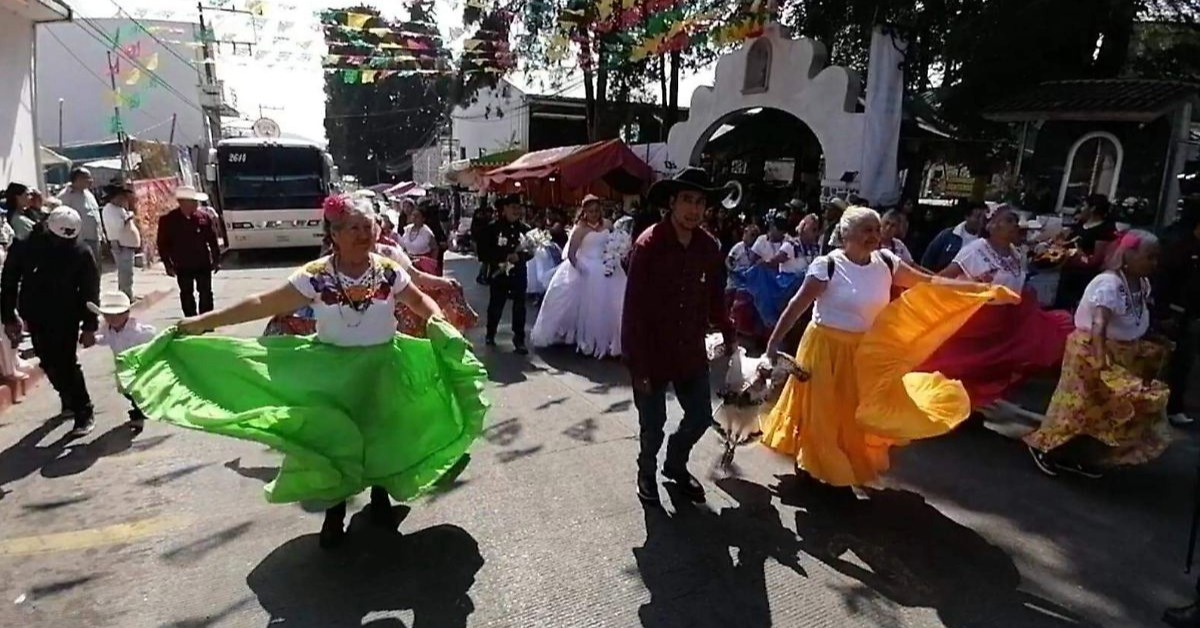
At weddings in Tetela del Volcán, the first dance may happen on the street. Older women step out of San Juan Bautista and lead a procession behind a banda, carrying a decorated turkey. Later comes the moment many guests wait for: an “echada de versos,” with rhymes that tease and instruct. The group behind the ritual began as an exercise class, then became a call list for families who want the old form. What keeps it going, and what does the turkey actually signal?
How the dance moves through a wedding
On many wedding days in Tetela del Volcán, the Baile del Guajolote starts outside the church. It does not start on a stage. Women from a local older-adult dance group step to a banda’s beat. The band is a brass-and-woodwind street ensemble. They lead the procession. A decorated turkey is carried at the front. It marks the walk from the Parroquia de San Juan Bautista toward the reception. The dance is built around roles guests recognize quickly. Someone escorts the couple. Someone carries the bird. Others keep time and keep the group together. Later, during the reception, the ritual shifts into wordplay. An “echada de versos” brings improvised rhymes for the couple and both families. The verses mix humor with clear, context-appropriate advice. The couple is not only watched. They step into the dance and take a turn carrying the turkey. In local terms, the bird is considered a sign of household abundance. In this format, music and verse do the work of a toast.
The women keeping the call list alive
The women who lead these processions organize under the name El Despertar del Volcán. It began more than three decades ago as an exercise group for older women. Over time, it shifted toward cultural work. For more than twenty years, instructor Victoria Landini kept classes running. She also helped formalize the group’s public role. Today, it has about twenty-five members. Some have danced the Baile del Guajolote at weddings for fifteen to twenty years. Among them are Julia Valdepeña, 77, and Hermelinda Pérez, 78. The group describes the dance as knowledge received from grandparents. It also keeps the door open to new learners. Girls, young women, and pregnant women can join rehearsals if they want. At weddings, the dancers do not charge a fee. They accept a small “recuerdito” and share the meal. They also stay reachable, so families know who to call for a traditional wedding. Members say the goal is continuity, not performance bookings.
More than a dance with a turkey
The turkey is not a prop. In many communities, carrying a guajolote during a wedding dance signals an exchange between families. Ethnographic accounts describe the bird moving from hand to hand as people circle and dance. The circle is often led mainly by women. In some places, the turkey is paired with other gifts. Those gifts can include a pork leg or, at times, a whole pig. The items are “danced” before they are delivered to the couple’s family network. The logic is public and practical. Food and labor are needed for the event and for the new household. So the gifts are shown, carried, and acknowledged in front of everyone. In Tetela del Volcán, the Baile del Guajolote is framed as a sign of prosperity and generosity. The dance turns support into something visible. It ties that support to music, shared memory, and community roles. It has also been presented in public cultural programming in Mexico City.
The Baile del Guajolote survives because public life still makes room for collective ritual. Tetela del Volcán sits on the slopes of the Popocatépetl volcano. It is in northeastern Morelos, Mexico. Its Temple and Former Convent of Saint John the Baptist (Tetela del Volcán) is part of a nearby UNESCO World Heritage site. Instituto Nacional de Antropología e Historia notes that the complex dates to the sixteenth century and served evangelization efforts. Wedding processions begin in that same parish setting today. They move from San Juan Bautista toward the meal and the dance. For expat residents, the tradition helps explain how obligations are performed, not just stated. It also shows why older women can hold cultural authority in public celebrations. The custom is not preserved solely by museums. It is maintained by neighbors who rehearse and accept responsibility to lead others. When the dancers choose not to charge, they keep the ritual accessible. That decision can matter as much as any symbol when weddings must balance cost and tradition.