A U.S. travel map is going viral online because six Mexican states now fall under the government’s highest warning tier. At first glance, the message looks sweeping. It is not. Mexico as a whole is still under a lower advisory, and many of the country’s best-known destinations fall outside the top-risk category. The bigger story is how a single map can make Mexico look uniform, even though the official U.S. warning system says the opposite.
A striking map, but not a single national verdict
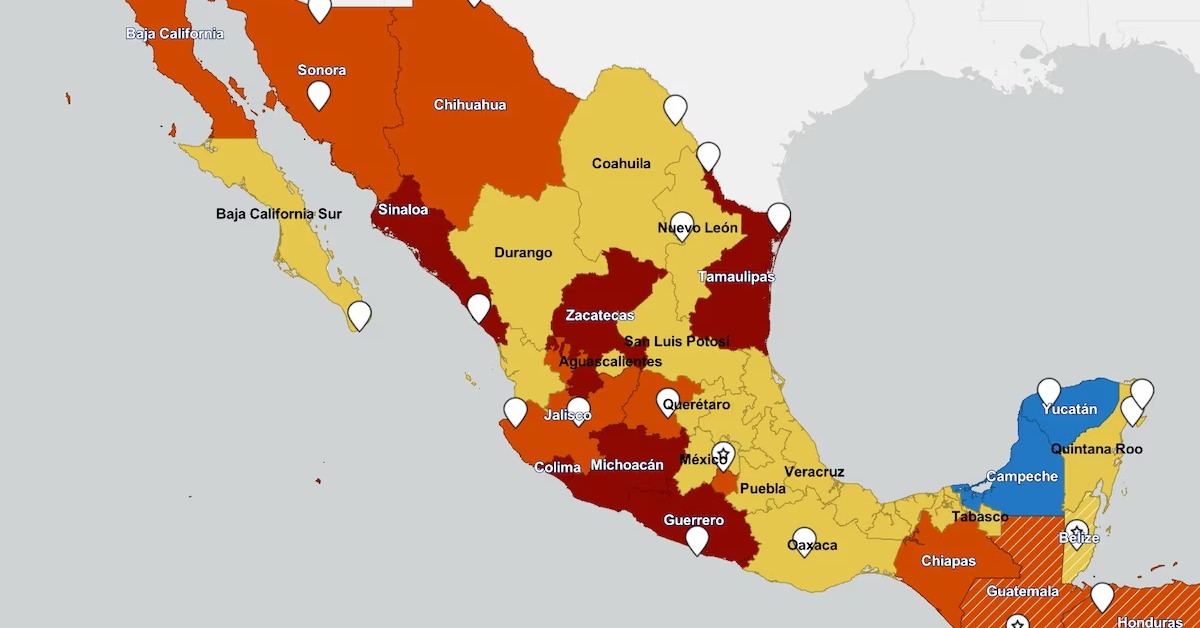
A new U.S. travel map is drawing attention because six Mexican states appear in the State Department’s Level 4 category, or do not travel. That is the agency’s highest travel warning. It is the same tier used for places such as Iran, Russia, and Somalia. The visual comparison is powerful, and that is why it is spreading quickly.
But the map leaves room for misunderstanding if readers stop at the headline. Mexico is not under a nationwide Level 4 warning. The country remains at Level 2, which advises travelers to exercise increased caution. The highest warning applies only to certain states. That distinction matters because Mexico is one of the few countries where the U.S. advisory is broken down by local geography rather than treated as a single uniform risk zone.
What the state-by-state system actually says
The six states now shown at Level 4 are Colima, Guerrero, Michoacán, Sinaloa, Tamaulipas, and Zacatecas. Those designations reflect the U.S. government’s view of serious crime and security risks in those places. The advisory also considers how easily U.S. officials can assist travelers during an emergency.
At the same time, much of the country sits below that level. Jalisco is listed at Level 3, which means reconsider travel. Mexico City is Level 2. Quintana Roo, which includes Cancún, Playa del Carmen, and Tulum, is also Level 2. Yucatán and Campeche are listed at Level 1, the lowest tier in the U.S. system. That means the same national map contains some of the lowest and highest warning levels at once.
This is the detail that often gets lost. The advisory is not saying all of Mexico belongs in the same risk category. It is saying the country is highly uneven. That may sound obvious to people who live in Mexico or visit often, but it is not how broad international headlines usually frame the country.
Why this matters to readers outside Mexico
For readers abroad, especially those with friends, family, or property in Mexico, the map can create a false sense that the whole country has shifted into one danger category. It has not. The U.S. system is more specific than that, and travelers should read it that way. A person flying into Mérida or Mexico City is not being given the same warning as someone planning overland travel through Tamaulipas or Zacatecas.
That does not mean the warnings should be dismissed. They can affect travel insurance, workplace travel rules, family visits, and public perception. They also influence how foreign audiences talk about Mexico. Still, the most useful reading is precise. Check the state. Check the route. Check whether travel involves remote roads or nighttime driving. Those details often matter more than the national label people share on social media.
The bigger story behind the headline
The real story is not that the United States has declared all of Mexico too dangerous to visit. It has not. The story is that a dramatic map is highlighting the deepest divide in how Mexico is viewed from abroad. Some states are designated as high-risk zones. Others are treated much more like mainstream travel destinations. Both things are true at the same time.
For expats and repeat visitors, that split will feel familiar. Mexico has long resisted easy national labels, whether the subject is safety, cost, development, or tourism. The U.S. advisory map now reflects that same complexity, even if the first impression does not. The strongest takeaway for readers is not to panic over the image, but to read the geography behind it.