Each spring, Yucatán’s stone cities behave like instruments. Sunrise lines up with doorways. Afternoon shadows form geometric steps along stairways. A camera catches the moment. The harder part is knowing exactly what you are seeing. Maya astronomers tracked seasons with calendars and with architecture. Some modern equinox customs reflect that heritage. Others are recent. With the March 20, 2026, equinox approaching, this guide clarifies timing, site logistics, and choices that keep the sky connected to living culture.
Spring timing and what equinox means in 2026
A Feb. 25, 2026 explainer from Heraldo de México Yucatán, by Sergio García, frames spring in Yucatán as a season when the sky becomes a cultural reference point. It points visitors to Chichén Itzá and Dzibilchaltún. It also widens the lens to cenotes, reserves, and community knowledge about cycles of time. The near-term anchor date is the March equinox. In Mexico City, it occurs at 8:46 a.m. on Friday, March 20, 2026. That instant marks when the Sun crosses the celestial equator, so day and night are close in length. Local experiences can land at a different time on the clock. They can also fall on a neighboring calendar day. They depend on sunrise or late‑day sun angles. For planning, treat March as a hotter shoulder season. In Mérida, average daytime highs rise through the month.
Maya astronomy in practice
Maya astronomy relied on observation and counting systems that made seasons predictable. Encyclopaedia Britannica describes the core model as two interlocking counts. One is a 260‑day ritual cycle. The other is a 365‑day year. Together they form an 18,980‑day sequence known as the Calendar Round. This structure matters for visitors because many architectural alignments can be read as calendar tools. Much of the detailed knowledge of the sky also comes from Maya books written before colonization. A glossary from the National Museum of the American Indian notes that only four Maya codices survived. It also explains that these books contain astronomical tables and ritual schedules. The best known is the Dresden Codex, which has a multi‑page Venus table. In scholarly descriptions, the Venus count is tied to a 584‑day synodic cycle and repeated phases of appearance. Debate continues over how scribes corrected that cycle to keep it useful across years.
Equinox alignments visitors can actually see
A widely photographed spring phenomenon is the descending “serpent” of shadow at Chichén Itzá. In its official site entry, Instituto Nacional de Antropología e Historia says a light-and-shadow pattern appears at each equinox on El Castillo’s stairway. As the Sun angle shifts, triangles of light and shadow appear to descend toward a carved serpent head. Many visitors link the effect to Kukulkán and seasonal renewal. Researchers debate whether “equinox” is the best label for the event. INAH lists public hours of 8:00 a.m. to 4:00 p.m. It lists an INAH entrance fee of 105 pesos. It also notes extra charges applied by the state government. UNESCO describes the site as a major Maya center of the Yucatán Peninsula. It highlights monuments such as El Castillo and the circular observatory called El Caracol. A UNESCO narration text notes 91 steps on each side. With the top platform included, this is often read as a 365‑day count.
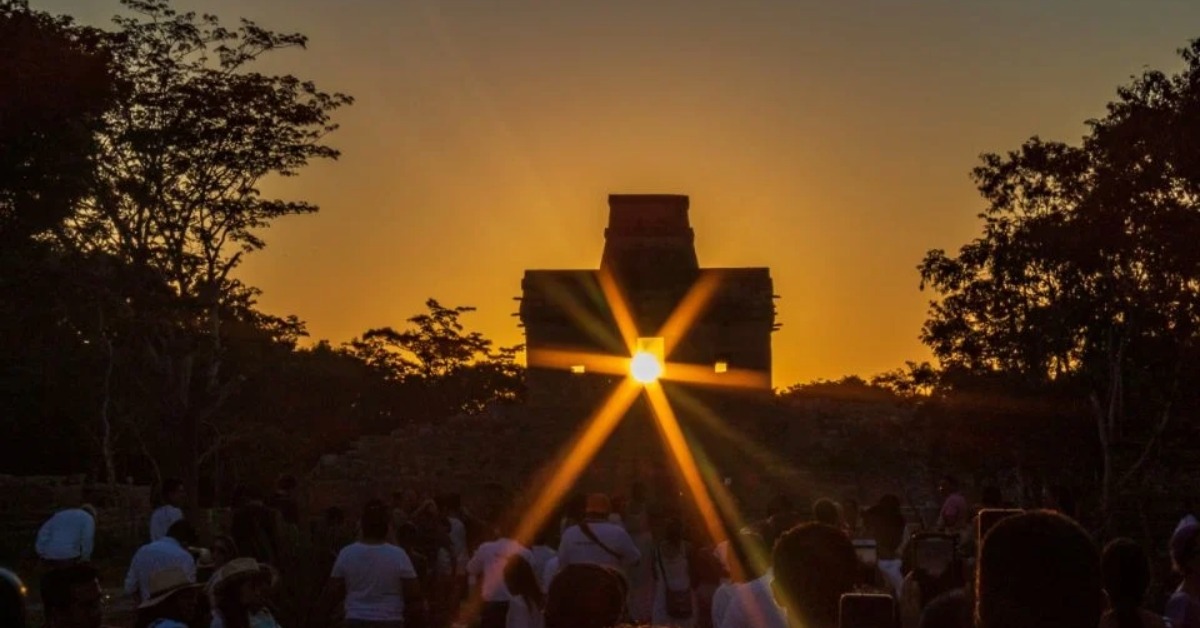
Dzibilchaltún offers a sunrise alignment that is easier to read and harder to time. In INAH’s profile, the Temple of the Seven Dolls is described as attracting visitors at the spring and fall equinoxes, when sunlight passes through the structure and illuminates the doorway. INAH adds a more specific claim: at dawn on March 21 and Sept. 21, a strong beam briefly crosses both doors of the shrine, and it records a traditional interpretation that this was a sign from Kinich Ahau for sowing or harvesting. The alignment is not described as perfectly exact. INAH notes the building’s plan is close to the cardinal points, with a roughly four‑degree deviation, and that dawn “near the equinox” can be glimpsed from the main sacbé and parts of the central plaza. For logistics, the same profile lists normal hours as 8:00 a.m. to 4:00 p.m. with a 105‑peso fee, and it posts a separate 730‑peso charge for visits outside normal hours.
What scholars debate about equinox traditions
The word “equinox” is a useful travel label, but it can mislead as a historical explanation. A 2023 synthesis published by Cambridge University Press argues that archaeoastronomy research in Mesoamerica shows widespread architectural orientations to the Sun. The key point is selection: many buildings were aligned to sunrises or sunsets on dates that form workable observational calendars. Those calendars helped schedule agriculture and related rituals, and they do not require the equinox as the primary target. The same work calls equinox-centered interpretations “deeply rooted but unfounded” in many cases. In a 2013 conference paper, Iván Šprajc and Pedro Francisco Sánchez Nava describe modern equinox gatherings as pilgrimages that can include esoteric movements and “energy” rituals. That does not make the gatherings meaningless. It shifts the question from “Was this the goal?” to “How is it used now?” For visitors, the practical takeaway is to treat equinox effects as seasonal markers, not as sole proof of design intent.
The Chichén Itzá debate shows how evidence and tourism expectations collide. Orlando J. Casares Contreras reviews the dispute in a 2017 INAH archaeology journal article. He focuses on calling the El Castillo shadow event an “equinox.” He notes that some researchers reject the term. They argue the pattern cannot fix an exact date with modern precision. Casares counters that ancient naked-eye observation did not need that precision. He describes “temporary equinoxes” that fall a day or two away from the astronomical event. He suggests a calendar logic that divides the year into 91‑day segments. He says the “descent” reaches full form across several days near the equinox. He lists examples around March 19–20 and Sept. 22–23. He then shifts to other sky stations that may matter more. He discusses zenith-passage sunsets around May 24 and July 19. He also explores a possible link to Venus synodic periods.
Nature, wellness, and living culture without losing the plot
The Herald article suggests balancing the temple visit with landscapes that make seasonal cycles visible. On the coast, two large protected wetlands offer that context without requiring specialized knowledge. Comisión Nacional de Áreas Naturales Protegidas describes the Reserva de la Biosfera Ría Celestún as a coastal zone that forms part of a wetland corridor along the state’s coast, and it notes Mérida as the closest major city, about 90 kilometers away. It describes the Reserva de la Biosfera Ría Lagartos as a biosphere reserve located where waters from the Gulf of Mexico and the Caribbean Sea meet. For spring visitors, these horizons matter because dawn and dusk are the same windows used to read temple alignments. March planning also benefits from a heat-first approach. In Mérida, typical March highs rise toward the mid‑90s °F by late month, which makes early starts more workable.
Wellness offerings can connect to living culture when the context is explicit and limits are respected. A useful reference point is the temazcal, a Mesoamerican steam bath with archaeological and community roots. Arqueología Mexicana defines temazcalli as a “house of steam bath” and notes its long social and religious role. An INAH-linked study by Agustín Ortiz Butrón stresses ritual function and cosmological meaning, not only therapeutic use. For visitors, that background supports informed consent and a cautious approach to heat exposure. Evening programs can extend the “sky culture” theme without claiming to recreate ancient rites. CULTUR—the Cultur trust that runs several site services—promotes the nighttime projection “Noches de Kukulkán” at Chichén Itzá. It states the show runs Wednesday through Sunday, starts at 7:00 p.m., and lasts about 30 minutes. At Uxmal, UNESCO’s dossier notes building orientations tied to astronomical phenomena such as the rising and setting of Venus, and INAH lists a related nighttime event called “Ecos de Uxmal.” UNESCO’s public listing also states that Uxmal’s layout reveals knowledge of astronomy.